Sunday, November 22, 2015

How to Ruin Your Startup in 7 Simple Steps

How to Ruin Your Startup in 8 Simple Steps


There are countless articles and posts out there that tell you what you should do in order to become a successful entrepreneur. Actually, we have published one as well not long ago (see How To Become A Successful Entrepreneur). However, as always there are two sides to that story. There are of course also some things you should not do if you want to successfully build your startup. 

So for the sake of completeness we decided to take a look at the issue from another perspective for a change. As a result, we came up with 7 simple steps to ruin your startup. But before you read on, please be advised that the following paragraphs may contain traces of sarcasm. In fact, some passages may even appear cynical to the attentive reader. So please, do not take the following list too seriously.

1) Do not take any risks

You have probably heard the phrase "no risk no fun" before. It's something crazy people say before they do stupid things. So unless you are into skydiving, bungee jumping, or any other activity that requires a death wish, there is no reason for you to live by that slogan. With regards to your startup it should also be pretty obvious why taking risks is a bad thing. Because it involves risk. Duh. To be fair in some cases, if you were to take risks, there might be a tiny chance of success. It might even turn out as the best decision you ever took and you could live happily ever after. But yeah, that's probably not going to happen and you'd most likely regret it for the rest of your life, so just don't do it. You know how they say in sports, "you can't win if you don't play." Well guess what, you can't lose either. But more importantly, if you don't play, you can still pretend you could have won. In other words, if you don't even start (i.e. don't take any risks) you can always tell people you've got the next big thing, without actually having to prove it, because they can't prove you wrong either. Genius.

2) Try to do it all by yourself

One of first and most important decisions you will have to face is, if you want to found your startup alone or with a team. Researchers generally suggest that startup teams are more successful than single entrepreneurs. Uhm yeah, they were probably thinking about teams like Mark Zuckerberg and his team, or Richard Branson and his team, or Jeff Bezos and his team... you get the point right? Let's face it, if you want to make it to the top, you will have to do it all by yourself. But that's not so bad actually, because there is probably no one out there who is as talented and capable as you are anyways. At the end of the day, you will be much better off if you don't have to babysit any cofounders or partners. It's not like they could contribute much to your idea in the first place. Worst case they would develop their own ideas and you'd have to argue with them and actually start thinking in more detail about your idea. Ugh. You don't need that kind of negativity in your venture. However, if you absolutely can't do it on your own for some reason, you might still have to include someone else. In that case, don't spend too much time looking for someone with similar ideas or a complementary skillset. It's not like you are going to listen to what they have to say anyways, right? So just go with the next best person you can find. 

3) Avoid talking to other people about your venture

This one should be a no-brainer. The only thing other people will do if you tell them about your venture is steal your ideas. It's sad but true. They won't even care about the fact that you probably have a significant advantage because you've already spent a huge amount of time working on your idea and developing it. They will start copying your idea immediately after you finish talking to them. You should definitely be worried about that. Everybody is a potential competitor. Just think about it for a second. Most people would rather pursue a vague idea (of which they don't even know whether it might ever be successful) than have a secure and high paying job. They are just waiting to jump ship and become entrepreneurs like you. So there is absolutely no benefit for you if you talk to other people about your venture. You'll hardly ever find anyone who will give you valuable feedback or offer new thoughts that hadn't crossed your mind before. And you won't be able to significantly increase your network either. And even if that were the case... you'd just end up with more people who could potentially steal your idea. So just shush.

4) Do not take advice from anyone 

If you follow step 3 (see above) you should not encounter too many situations where people try to give you advice. However, if it still happens, you shouldn't take it. There is absolutely no added value in doing so. What could these people possibly know that you have not already considered? And if they actually did come up with something you have not thought of before, of what importance could that possibly be? Given the fact that you're probably the only one who truly understands your business idea anyways, you are the expert. There may be other people who work in the same industry or people have successfully founded multiple companies similar to yours, but that does not make them any more of an expert than you are. They may be more experienced than you, but we all know that experiences are made in the past. You don't take advice from a history book, do you? No, because you are not trying to be successful yesterday. Your time is now, you are here to shape the future.

5) Make sure your product is perfect right from the start

The last thing you want to do is enter the market with an unfinished product. If you want to be better than the market, your product has to be better than your competitor's offering. In fact, it doesn't only have to be better, it has to be perfect. Right from the start. Think about it, no one is going to buy a product that does not meet their needs. When was the last time you bought something you were not completely satisfied with (except for all the occasions you probably just remembered). Anyways, since you don't exactly know who your customers are, you just have to meet all potential needs. Yup, all of them. Some people like small cars, others like big cars. So your car has to be small and big at the same time. Some people like red jackets, others like blue ones, so your jackets have to be red and blue. Don't settle for just one out of two customers if you can have them both, even if you can't. Just make sure your product is perfect for everybody before you enter the market and you will be fine. It's that simple. 

6) Don't waste money on promoting your product

Ok, if you've done everything right, you should have a perfect product by now. So far so good. But you are probably wondering how you are going to get people to buy it. Should you spend a fortune on advertising or any other type of promotion? Nope, definitely not. Let's look at the reasoning behind this. Companies need promotion to convince people to buy their products. But unlike all the other companies your product is perfect, so there is no need to convince anyone. People will want to buy it as soon as they see it... they would be foolish not to do so. And they will tell others about their great purchase, so word-of-mouth will do all the work for you. No need to spend big bucks on advertising. And if for some odd reason, there are still people don't want to buy from you after all... well, joke's on them, because they are the ones who are missing out. It's not like you need them. They'll soon enough realize they are the ones who need you. So just sit back and wait for them to come back. 

7) Stick with your initial plan

Now that we have covered the most important aspects, there is just one last thing to remember: never change your initial plan! If you have done everything we mentioned above, there is really no reason why you would have to reconsider anything. Yeah, maybe the circumstances have changed, that is possible. That actually happens quite often, to be honest. But why would you have to adapt to them? Let's it real here for a moment; your plan was perfect when you developed it, so it must still be perfect simply because you haven't changed anything since then. The mere fact that it is not suitable for a given situation anymore should not discourage you. Why don't you just go out there and try to change the world instead of your venture? That's long overdue anyways. Just look at all the things that are going wrong out there at the moment. And while you are at it, just recreate your environment the way you need it. This is how most people do it, so it must be right. 

In a nutshell

There are countless articles and posts out there that tell you how to successfully build your startup. However, there are two sides to that story, so for the sake of completeness we decided to take a look at the issue from another perspective for a change. As a result, we have come up with the following 7 simple steps to ruin your startup: 1) Do not take any risk, 2) Try to do it all by yourself, 3) Avoid talking to other people about your venture, 4) Do not take advice from anyone, 5) Make sure your product is perfect right from the start, 6) Don't waste money on promoting your product, 7) Stick with your initial plan. If you follow these simple steps your startup won't last very long... guaranteed!

Thursday, November 19, 2015

Black hats - or grey?

Yesterday I posted about how I liked where MBIE's review of the Commerce Act had got to with its conclusion that section 36 of the Act - the bit that aims to curb firms with market power from nobbling the competitive process - wasn't working as intended.

But there was one comment in the review that jarred with me at the time, and after thinking about it for a while, I've figured out why.

It came in the bit on p29 where MBIE was talking about how the way s36 works in the courts stacks up against the criterion of 'simplicity'. They were right to say, not well, in particular from the point of view of a plaintiff (typically the Commerce Commission, but firms can also have a go at private prosecutions). When the courts decamp into the alternative universe of the 'counterfactual' - what would firms have done in a hypothetical world where they didn't have market power - the possibilities for rabbits to run in every direction are endless. MBIE was right to call the process "defendant friendly".

But along the way MBIE said this (I've added the bit in brackets to make MBIE's point clearer):
The problem here is not so much one of predictability for powerful firms – businesses will generally know if they are acting in a way that they would not in a competitive market. The problem seems instead to be the cost and delay involved in [the plaintiff] making a case under the counterfactual test
Frankly, the first sentence is just plain wrong (the second is mostly right).

Businesses very often won't know if they are acting in a way that they would not in a competitive market. That's precisely why we, and the Aussies, and competition authorities globally, have been having these rethinks about defining abuse of market power and policing it: it's a grey area, where reasonable people can come to different conclusions. What is vigorous but fair competition by a big company can be very hard to tell from tactics that exploit the company's bigness to skew the competitive playing field. In fact, that's exactly what the (in)famous Pink Batts case (which MBIE cites) demonstrated: courts took different views, with the House of Lords, who had the last bite of the cherry, taking the vigorous but fair line.

The biggest current example is Google's bunfight with the EU competition police. Is it really abundantly clear that Google's giving higher rankings in search results to companies that advertise with it is "anti-competitive"?  If you, um, google it, you'll readily find experts on both sides.

I wasn't born yesterday: of course, there will be instances where there are guys in black hats who know they are wearing them. There have been clear cases where competition authorities have spotted and pinged egregious behaviour that would have been found anti-competitive on pretty much any reasonable definition of abuse of market power.

But it's not the right way to typify where many companies are likely to find themselves - in the real, greyer world.

Wednesday, November 18, 2015

Good outcome - but now what?

Earlier this week MBIE came out with its 'Targeted Commerce Act review', which contained its long-awaited revisit of s36 of the Commerce Act - the bit that deals with anti-competitive use of a position of market power. It also included a review of non-litigation remedies available to the Commerce Commission (such as settlements, and cease and desist orders), which I hadn't known it was looking at, and the case for market studies, which I did. I'll come back to the remedies and market studies in another post.

The big news - and it's good news - is that MBIE has got to the same place that many others have got to with s36: it's broken and effectively unworkable. That's essentially what the Commerce Commission has been saying, in more diplomatic language, in (for example) its latest Statement of Intent (p16):
There is still uncertainty about the application of section 36 of the Commerce Act, which deals with monopolistic conduct. The way New Zealand’s courts have interpreted section 36 has created difficulties in applying the law. Given the complexity and cost of these types of cases, we choose very carefully which potential monopolisation cases to investigate. We would like to see a review undertaken of section 36 and will contribute to any potential reform in this important area
MBIE has got there as well, for two main reasons. One is that it felt that the current law, and its interpretation by the courts, risked letting companies get away with anti-competitive behaviour because it is too easy to claim that it's what any company, with market power or not, would have done. It gave this example (p28):
Exclusive dealing, for instance, frequently occurs in competitive markets as businesses seek to control the distribution of their products. However, the same conduct when carried out by a business with substantial market power can result in significant competition detriments, at worst eliminating all competitors from the market.
MBIE also cited (p28) a statement by the chair of the Aussie ACCC stating that it had been unable to ping a range of anti-competitive behaviour under the equivalent provision of the Aussies' legislation.

The other main leg of the argument is that the legal hoops a plaintiff has to jump through to make out a s36 case fail the criterion of having simple, comprehensible competition legislation. This is the key bit (p29), and I couldn't agree more:
The evidential burden for the plaintiff of proving a hypothetical counterfactual is simply too heavy in many cases. In particular, a mandatory requirement to construct a hypothetical competitive market of at least two participants requires difficult assumptions to be made. These difficulties are compounded by the courts’ observation that the analysis need not depend on realistic or practical assumptions, so that unrealistic scenarios are permitted. Such an evidential burden for the plaintiff has increased the complexity of the section 36 process. The prohibition has ultimately become defendant-friendly.
MBIE also looked at s36 and the courts' interpretation of how to apply it against the criterion of consistency - internal consistency with other parts of the Commerce Act, and consistency with what other countries do - and found that our current approach fluffs it on both counts. For example, "section 36 is significantly different from equivalent provisions in the US, the European Union and Canada" (p30).

MBIE couldn't decide how another criterion might be applied - whether some allowance ought to be made for our being a small, remote economy. Should we ease up on policing behaviour, on some kind of 'national champion' grounds, or be especially vigilant when we've got more than our fair share of large fish in small ponds? Can't say I've got the same difficulty deciding - 'No national champions, please'.

The review was a problem-definition issues paper, so it didn't march smartly on to proposed policy solutions, but it indicated a whole range of possibilities, including, I'm pleased to say, the route the 'Harper review' of Australian competition policy took.

But getting anywhere with them  is going to be tortuous. For me, the next steps look glacially slow. People have till next February to get their views in to MBIE on this review, at which point there may or may not be an Options Paper, which in the grand fullness of time will have its own submissions and countersubmissions, and may or may not lead to proposed legislation (possibly with another round of submissions), and which will finally struggle to get a slot on the already overcrowded Parliamentary calendar (have you seen what it looks like? It's horrendous). And all this on a topic that (as some media comment has already said) may not be popular with Big Business.

It's too late now: the lumbering siege machine has started to trundle into the far distance, and it can't be called back. And it's good that it's probably going to arrive at a better place. And yes, there's a case for thorough policy preparation and legislative design.

But if we'd had more sense, and urgency, we could have moved straight to the Harper review endpoint. Free ride on the Aussies' expertise? Check. Good outcome? Check. Faster result? Check. Consistency with our trans-Tasman mates? Check. As I've argued before, 'Australia's got the competition gospel. Have we?'

Monday, November 9, 2015

Interesting details from the OECD

Last night the OECD came out with the latest update to its Economic Outlook - you can read the whole thing here (the chapter on New Zealand starts on p189) and access the statistics behind it here.

There were no huge dramas in the commentary: keep fiscal policy on a conservative course, loosen monetary policy some more (the OECD expects the official cash rate to drop to 2.25%), watch out for the Auckland housing market, do something about easing Auckland housing supply.

But the detailed numbers were nonetheless interesting. Here's a selection.


On the GDP front, 2016 could be tricky: forecast 1.9% growth doesn't leave much room for error if, say, China or El NiƱo spring an unpleasant surprise. And you do wonder about where longer-term growth is going to come from if (as the OECD thinks) the housebuilding boom loses its oomph. Investment in non-housing capital goods growing at only 2.0-3.0% a year isn't doing much to increase our productive capabilities.

And that's where we get to the more interesting numbers. The OECD's got an estimate of how fast our economy can grow (the 'potential output' line). Sure, these potential output 'speed limit' calculations can be flakey, but that said, on its face the news is not good. Our current potential growth rate of 2.5% is not flash, and is likely to fall a bit over the next couple of years. One or more of labour force growth, capital investment, or productivity has got to start picking up if we're not going to be lumbered with growth rates a lot lower than we'd like.

You can also see how the OECD gets to its case for easing monetary policy. Forecast inflation is below the RBNZ's target mid-point, the economy is operating below full capacity (that's the 'output gap' line), and the forecast unemployment rate is above the 'NAIRU' level where (in theory) a tight labour market would start to generate wage pressures. NAIRU estimates are just as iffy as potential output, and on nothing more than hunch I'd say the NAIRU could be lower than the OECD thinks, but either way there's clear room for monetary policy ease.

I've put up the financial markets forecasts for reference. Recent history, home and away, of forecasting interest rates and exchange rates has not been, um, a complete success, but in any event short term rates are headed down as the RBNZ cuts, and the dollar eases a little, but longer term rates are heading north: the driver is the US bond market, where the OECD expects the long term bond yield to rise from 2.1% this year to 3.2% in 2017.

Wednesday, November 4, 2015

What's behind those jobs numbers?

Yesterday's labour market figures, and particularly the employment outcome and the participation rate, came as an unwelcome surprise to everyone. The consensus expectation amongst economic forecasters had been that employment would rise by 0.4%, whereas it actually fell by 0.4%, and the participation rate (the proportion of the population in the labour force), which had been expected to hold up at its historically high 69.3%, dropped back to 68.6%. Given that a falling participation rate is usually taken as a sign of a weaker labour market, since people tend to leave the labour force when they become less confident that jobs are available,  the employment and participation numbers taken together showed an unexpectedly soft jobs market in the September quarter.

On the other hand, though, there were some oddities in the numbers. Employment certainly went down, but the number of filled jobs, and the total number of hours worked, both rose during the quarter, and those increases would tend to suggest that the labour market was a bit better than previously.

The different outcomes got me wondering about how these three measures - employment, filled jobs, hours worked - have behaved over time. Here's the answer, since the start of 2000.


Generally they move together, as you'd expect. There is the odd occasion, as in this latest September quarter, when employment falls but the number of jobs and the hours worked rise (March 2000, September 2006, September 2012). There is even the odd occasion where the opposite happens - employment rises but jobs and hours fall (June 2005, March 2008, June 2009, June 2015). But as a rule they tell the same story, and quarters like this June (employment up, the others down) and this September (employment down, the others up) are the exceptions.

What's happened, I reckon, is that there was clearly some general slowing of the economy earlier this year, with an impact on the labour market, but  we're also seeing the impact of quite a lot of noise in the data. Over the long run (back to early 1989, when the jobs and hours series start), all three measures have almost exactly the same average growth rate: employment, jobs and hours have each grown, on average over the long haul, by 0.4% a quarter. But there's a lot of volatility in the three numbers: if you look at the standard deviation of each one, for employment it is 0.6%, for jobs 0.8%, and for hours worked it's 1.0%. As a rough rule of thumb, even if the underlying 0.4% hasn't changed at all, two thirds of the time you're going to see employment numbers between -0.2% and +1.0%, jobs numbers between -0.4% and +1.2%, and hours numbers between -0.6% and +1.4%.

The overall lesson is that you're probably best advised not to get fixated on any one of the three measures: employment is somewhat less volatile than the others, and to that extent it's more of a reliable pointer than the other two, but they're best considered (a) in the round and (b) on timeframes longer than a single, possibly unrepresentative, quarter.

If, for example, you look at 2014 as a whole, the average quarterly increase in employment was +0.89%, the average increase in filled jobs was +0.61% and the average increase in hours was +0.74%. In the first three quarters of this year, the same averages were +0.12% (employment), +0.56% (jobs) and +0.77% (hours). So you'd conclude, overall, that there has been some modest slowdown: employment on its own would point towards a reasonable slowdown, but the other two point to little or none. That's not at all surprising, given the effect that falling dairy prices were having at the time. A modest slowdown, but still ongoing growth in employment, is also exactly what you see in the employment component of the ANZ's business survey, so it all fits together nicely.

Tuesday, November 3, 2015

How's life? Pretty good

A day when we got news that employment fell, and the unemployment rate rose, may not be the best time to argue that New Zealand is in pretty good shape when compared with the rest of the world.

But that's the case nonetheless, as the latest How's Life 2015: Measuring Well-being report from the OECD shows. The report is part of a growing - and welcome - global focus by various agencies (including our own Treasury with its 'Higher Living Standards' framework) on a wider range of societal outcomes than just GDP.

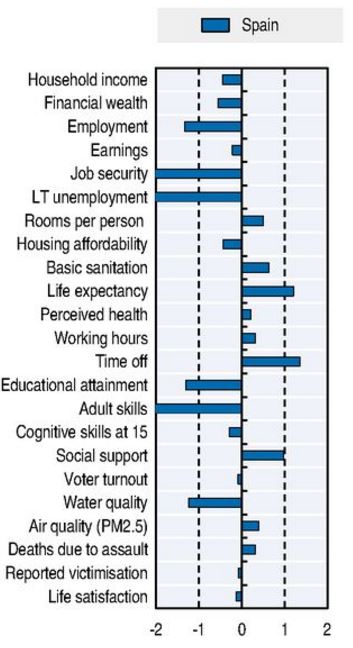
Here's how New Zealand stacks up against the rest of the OECD on a broad range of economic, social and environmental criteria. The scores are standard deviations above or below the OECD average, and anything bigger than +1 or lower than -1 is pretty unusual. Hat tip, by the way, to Timothy Taylor's excellent Conversable Economist blog, which is where I came across the news that the OECD had done this latest exercise.


Sometimes when organisations do these comparisons, the results don't always resemble the country you know, but this looks about right to me. By international standards, we're on the right side of the ledger for most things - and very much so on the size of our houses, our perceived state of health, the cleanliness of the air and our ability to get people into employment. You can see - if you use the "life satisfaction" measure at the bottom as an overall summary - that we are travelling well by international standards.

Where do we lag? There's nothing outrageously bad, but the one drawback that sticks out, housing affordability, will surprise no-one (here defined as "Percentage of household gross adjusted disposable income spent on housing and hosue maintenance", but we'd have shown up badly no matter which precise measure you used). We also work too much and don't take enough time off, and have a slight issue with educational attainment (and, I'd say, if you peeled back the overall educational showing, a particularly knotty issue with the bottom tail of the educational attainment distribution). And everyone would prefer if we were above the OECD average for household income rather than slightly below. But overall this is a good score-card.

I'm a little surprised we don't have data on all the criteria (if you're interested in the definitions, they're on p26 of the print edition or p28 of the e-book, and these country graphs start on p47/p49). 'Financial wealth' is defined as 'net household financial wealth', and something very much like that is available on the Reserve Bank's website (here). I'd have thought we had the data on earnings and basic sanitation, too. The 'adult skills' measure is the only one where I can see a good reason for missing data: we aren't apparently part of the OECD's Programme for the International Assessment of Adult Competencies (PIACC). Don't know why - the rest of the OECD seems to have signed up (33 of them) - but there you are. But even if you filled in the blanks, it wouldn't (at a guesstimate) have changed the overall picture.

There's much more in this report than just country league tables, and I'd recommend it to anyone with an interest in social welfare broadly defined,  but I suspect people will still want to do the usual comparisons, so here's how Australia looks.


Very similar, but richer, in sum. And if you ever wanted a simple graphic showing the need for structural reforms in some economies, here's Spain.


Tuesday, October 27, 2015

Scene-setter for tomorrow's RBNZ decision

Tomorrow we get the latest Official Cash Rate (OCR) review from the Reserve Bank, so by way of a scene-setter here's my latest calculation of the overall tightness or looseness of monetary policy, as measured by the Monetary Conditions Index (the MCI), which combines the impact of interest rates (90 day bills) and the exchange rate (the TWI) into one summary index number. If the MCI is all news to you, there's an older post about it here.

This time round I've just shown the last 10 years and a bit, including my estimate for October (based on bills at 2.9% and the TWI at 72.9).


The latest consensus from polls of economists is that the Bank will leave the OCR alone at 2.75% tomorrow - a change from an earlier view that another 0.25% cut was almost a certainty. The main reason appears to be that the economic forecasters are placing quite a bit of weight on the keep-the-powder-dry bit in the Governor's recent speech where he referred to "the need to have sufficient capacity to cut interest rates if the global economy slows significantly".

It's possible too that the recent improvements in business and consumer confidence, and robust results from the BusinessNZ/BNZ surveys of manufacturing and services, mean that the RBNZ doesn't need to be in such a hurry to provide some extra stimulus to the economy, which seems to be coming out of its dairy-price-slump attack of the glums.

Me? I can see some value in hanging about till the next Monetary Policy Statement on December 10 and getting a better bead on the economy, and what's six weeks in the great scheme of things anyway, but for what it's worth I'd cut tomorrow.

For a start, there's been that recent sharp rise in the TWI: the Kiwi dollar is up by nigh on 7% in overall value from its low point on September 23. And as the MCI graph shows, that move in the exchange rate has been enough to take the overall bite of monetary policy onto the tighter side of neutral. You can't keep fiddling with interest rates every time the dollar ducks and dives - which is why the MCI was abandoned as a policy tool - but equally you can't be completely indifferent to overall monetary policy being tightish when it actually needs to be loosish. The big picture here is that we (like many other countries) have been undershooting our inflation target: monetary policy needs to move into a modestly stimulus/inflationary space. Standing pat won't get us there. If it's steady tomorrow and a cut in December, no great harm done. But there needs to be a cut sometime soon, and especially if the Kiwi dollar keeps strengthening.