Showing posts with label Australia. Show all posts

Tuesday, July 26, 2016

The fur is flying in Oz - and maybe will here, too

We're in the process of having a rethink about our 'abuse of market power' legislation - s36 of the Commerce Act (if you're new to this you may want to have a quick read of 'The law is an ass' and 'Get your views in on abuse of market power').

It's partly because the Aussies have also got the ball rolling. In fact, they're ahead of us, as the Coalition government over there has decided to change the Aussie law, in line with the recommendation by their 'Harper review' of competition policy, while we're still at the consultation stage. The gist in Australia is that the law will switch from a focus on the purpose a firm with market power may have had when it did something, to a focus on the effects the firm's actions have on the competitive process.

I think it's a sensible move, and I've been arguing for doing the same here. We currently have pretty much the same wording in our law that the Aussies have decided to change in theirs, and we can get a free ride on their (very extensive) process of competition policy development. And if the Aussies change, we don't really have much choice in the matter, as we'd be left high and dry with an ineffective archaism of our own.

In Oz, however, the proposed change has sailed into a new political squall. Reform of important legislation affecting big business always tends to have its tricky moments: what set it off this time was a comment by Australia's Productivity Commission in its recently released draft report on agricultural regulation (if that's your thing, the overview is here and the full report here). Along the way the Commission had said (p431)
Some competition law experts argue that pressure to amend section 46 [the Aussies' version of our s36] is based partly on wanting to shield small businesses from competition. For example:
Section 46 is designed to ensure those with market power don’t use it to insulate themselves from competitive pressure; but s46 shouldn’t be used to insulate small business … (Trindade, Merrett and Smith 2013, p. 6)
The introduction of an ‘effects’ test to section 46 is unlikely to shield farm businesses from intense competition in retail grocery markets. Shielding farm businesses from competition would also not be in the interest of consumers.
What the Commission said, in short, is that even if the effects test was enacted, it wouldn't actually serve as protectionism for farmers, and in any event protecting groups from competition would be a bad idea. All good.

But then up pops a press release from the Opposition competition spokesman Dr Andrew Leigh, quoting that bit from the Commission saying an effects test won't help farmers and adding
An effects test won’t protect producers, but it will raise grocery prices and threaten retailers with court action if they become too competitive...Labor remains opposed to the effects test as it will have a chilling effect on competition and raise prices on everyday groceries such as bread and milk
He also went on, rather incongruously for a Labor politician I thought, to recycle a number of anti-effects-test statements from the big business end of town, and finished by arguing that the effects test was in reality a plot by the National Party component of the Aussie Coalition to protect small businesses against competition from large ones.

The notion that the proposed law change, intended to increase competition by preventing anti-competitive standover tactics from those with market power, was actually A Cunning Plan to decrease competition by protecting small businesses, has predictably sent the proponents for change well-nigh berserk.

Ian Harper, who led the Aussies' 'Harper review' of competition policy that came up with the proposed change, responded by telling The Australian newspaper* that the effects test "has been misinterpreted to an “almost wilful” degree", that "characterising the proposed reforms as protectionism was “to turn reality on its head”", and that "The point of the act is to protect the competitive process, not individual competitors".

Rod Sims, the chair of the ACCC, who supports the change to an effects test (and who has also supported our Commerce Commission in pressing for the same change here), was even blunter. He said, again in The Australian*, that "framing section 46 reform as protectionist policy driven by the National Party is “bullshit”, and has slammed big business for distorting debate around the so-called effects test laws", and "Sure, they’re (the Nationals are) in favour because they like the little guy being able to compete with the big guy. But that’s what we want: we went competition, everybody should want competition. We don’t want large companies preventing competition.”

I wouldn't be in the least bit surprised if something like this bunfight plays out here in New Zealand, too. It might be a step too far for our Labour opposition to rise in the House to champion the rights of the supermarkets and other big firms, but in the opposition for opposition's sake game that both our big political parties play, who really knows. I just hope that, in the end, the Harper and Sims views make it through the political minefield.

*I haven't included direct links to The Australian articles because there's something of a random process around The Australian's paywall - you might get through, but you might not, either. If you google 'Ian Harper slams ‘effects test’ reform critics for distortion' and 'ACCC slams big business for effects test distortion', you can usually find access either to The Australian site or to other sites that have carried the articles.

Thursday, July 21, 2016

Time to revisit "hard core" cartels

Earlier this week the European Commission fined four truck makers €2.93 billion (NZ$4.6 squillion at the current exchange rate). A fifth, the German company MAN, wasn't fined because it ratted the others out, and under the Commission's cartel leniency policy (and our own Commerce Commission's), the first company in the door to renege on the others gets off any fine (though it and its cartel mates remain exposed to civil suits for damages). A sixth company, Swedish based but Volkswagen controlled Scania, didn't settle with the Commission and is being pursued separately. Full details here.

This was your classic "hard core" cartel - secret, prolonged (14 years), deliberate, and significant. As the European Competition Commissioner said
there are over 30 million trucks on European roads, which account for around three quarters of inland transport of goods in Europe and play a vital role for the European economy. It is not acceptable that MAN, Volvo/Renault, Daimler, Iveco and DAF, which together account for around 9 out of every 10 medium and heavy trucks produced in Europe, were part of a cartel instead of competing with each other.
The European Union hasn't criminalised cartels, meaning that executives can't be jailed. Member countries weren't prepared to give the Commission the authority, and have gone their own ways: some have chosen the criminalisation route (the UK, Ireland), most haven't. But if ever there was a European case where executives needed to have their collars felt, this was it.

By coincidence, a couple of days earlier the ACCC announced that NYK, the Japanese shipping company, had pleaded guilty to criminal cartel conduct involving the shipping of vehicles from Japan to Australia in 2009-12. It's been a while coming: this was the first criminal case since the Aussies criminalised cartels in mid 2009. We don't know who the other alleged parties to the cartel are. We don't know if anyone at NYK is packing their toothbrush.

When I see cases like these, I can't help thinking - again - that we made the wrong decision last December in flagging away cartel criminalisation in New Zealand. I've posted before that "Hard core" cartelists are criminals and what our response should be: Let hard core cartels off the hook? Nah.

Bear in mind that I'm a bleeding-heart raised-in-the-Sixties liberal, and I'm hard to convince that we should imprison people for anything short of grievous bodily harm or broadcasting reality TV programmes. Bear in mind, too, that I'm generally pro business, strongly pro markets, and slow to buy into heavier regulation or enforcement without an industrial strength, convincing, evidence-based case. But when these genuinely "hard core" cartels crop up, even I am prepared to reach for the handcuffs.

Thursday, June 16, 2016

Competition is good for you, part 293

The Reserve Bank of Australia came out with its latest Quarterly Bulletin the other day, and in it there was a fascinating article, "Why Has Retail Inflation Been So Low?".

The authors wanted to find out why inflation in the Aussie shops was running lower than would have been expected, given the level of the Aussie dollar, as can be seen in the graph below, where the dark blue line (inflation)  has been lagging below the pinky-purply one (the changing value of the A$).


And when they looked at it more closely they discovered an interesting thing. They disentangled what happens when exchange rates change. There are two steps: the first is the impact on the landed Aussie cost of imports (which goes up when the A$ falls and down when it rises), and the second stage is what happens to that changed landed cost of imports as it works its way through the wholesale and retail domestic distribution chain.

What they found was that the first stage hadn't changed at all: a lower A$, for example, was still feeding through to higher landed A$ costs of imports, just as it always did. But the second stage had changed quite a lot: from about 2010 onwards, there was less pass-through of those higher import costs into final consumer prices, as the graph below shows.


They weren't able to nail what had changed in the second stage using econometric methods, other than to confirm that statistical tests did indeed confirm a change in behaviour, so they had a qualitative fossick instead, based on what the RBA had been picking up from its regular programme of going round and talking to businesses ('liaison' in central bank geekspeak).

Increased competition appears to have been the reason (my emphasis added):
Liaison with retailers suggests that over the period of interest, competition in the retail sector has intensified, partly due to increased supply. There are numerous sources of this increase in competitive pressures, although some key themes have emerged from liaison.
Technology has enabled consumers to compare retail prices quickly and easily online and determine which retailer(s) are offering the lowest prices. The increasing online presence of traditional bricks-and-mortar retailers is contributing to this effect.
• Relatedly, the supply of retailers has increased due to competition from foreign online retailers. This was particularly evident over 2010–13 when the exchange rate was relatively high...Over this period, domestic retailers became relatively less competitive against competitors based offshore.
Both established firms and new entrants, including international retailers entering the Australian market, are competing aggressively to gain market share
They also found an interesting phenomenon where in a number of sectors, there was an especially aggressive competitor who was making life tough for the rest of the players:
In a number of market segments, liaison has attributed the increase in retail competition to the actions of a perceived ‘market leader’, which is generally looking to expand their market share, effectively increasing supply. This has led a number of retailers to report that they believe demand for their goods is very price sensitive, and fear that they will lose sales volumes if they increase prices. Earlier work on Australian retailers found that a majority of firms primarily set prices based on the balance of supply and demand factors, such as market conditions or competitors’ prices, rather than setting prices as a fixed mark-up over costs
Competition in turn was forcing firms to improve their efficiency if they wanted to maintain previous levels of profitability, pushing them to look for "labour productivity gains through technological improvements, such as contactless payments systems, self-serve checkouts and better monitoring of staffing needs" and "other means, such as bargaining for lower rents, improving inventory management, sourcing from fewer suppliers, partnering with other firms to lower distribution costs and centralising some administration tasks".

What a nice textbook outcome from increased competitive pressures: consumers have got a better deal, and producers have been pushed to improve their productivity. And it comes in a week where the latest instalment of MBIE's electricity price monitoring showed that retail electricity prices had dropped for the first time in 15 years, which MBIE said "was driven by increased discounting activity and incentive credits" - greater competition, in other words. Carl Hansen, the CEO at the Electricity Authority, said that the price fall "is one of the many indicators of strong competition in [the] residential electricity market. Another indicator is that smaller retailers have now grown their market share to 10 per cent which is putting significant pressure on the larger retailers".

It may be making a meal of the obvious, that competition is pro-consumer and pro-productivity, but the message doesn't always get through in New Zealand, or elsewhere. The lobbyists for the quiet life in sectors such as education, health and the professions are good at running the pro-producer line, and (like in bunfights over trade protectionism) the voice of the consumer doesn't get the hearing it should.

We need more competition across more markets, and you don't have to take just my word for it. The OECD, in the chapter on New Zealand in the latest update of its Economic Outlook, said that "Reducing barriers to FDI [foreign direct investment] and to competition in the electricity, transport and telecoms sectors would facilitate greater investment and innovation, increasing productivity and reducing prices". There's work to do if we're going to have the retail price and producer productivity benefits Australia is enjoying, and more of our utility bills going down.

Thursday, May 5, 2016

Hold the rotten tomatoes

Every now and then (my last one was here) I've counselled folks to have a bit of forbearance when it comes to getting stuck into finance ministers or central bank governors. If they've stuffed something up because of mistakes any sensible person, in possession of the same data and same policy mandate at the same time, would not have made, that's one thing: throw the rotten tomatoes by all means. But that's not often the case: more often, they - like the rest of us - are manoeuvring best they can in a statistical fog, not entirely sure where they are, let alone what's round the next fogbank.

Today's Statement on Monetary Policy from the Reserve Bank of Australia had some graphs that make the point quite well. Here are the RBA's forecasts for Aussie GDP growth, core inflation, and the unemployment rate over the next two years - plus the confidence intervals around the central forecast, based on how well the RBA's forecasts have actually turned out since 1993.


Even if you are a good forecaster - and central banks tend to be at least as good as any others in the forecasting game - and your best guess is that GDP growth will be a little over 3% in two years' time, the likelihood (going by the 70% interval) is that it's actually going to be somewhere in a band from a bit under 2% to around 4.5%. 

In other words, your best call is that the economy is growing at or a little better than trend, and you probably don't need to do anything to monetary policy from a growth perspective. But it might turn out (given that monetary policy has long lags) that right now you should easing (because the economy is actually heading for well-below-par sub-2% growth) or that you should be hitting the brakes (because it could as easily be heading for boom-time 4.5% growth). And bear in mind that there's roughly a one in three chance that the actual outcome might be something else again - even slower or even faster. And (as you'd expect, since they're all linked) there are similar uncertainties over inflation and unemployment.

Let's not forget, either, that this is uncertainty about the future, when, in addition, there's uncertainty about the starting point of the here and now. That's why the Fed of Atlanta, for example, has felt it needed to come up with its "nowcast" of where US GDP currently lies. The rotten tomatoes will have their uses someday, but the reality is that monetary (and fiscal) policy making, real time, is a lot more difficult than it's often given credit for.

On the substance of what's actually happening in Australia, I was interested in these two graphs.


In the top one, you'll see that non-tradables inflation, the pricing pressure generated domestically and the only bit of inflation that a central bank can really expect to control over the longer haul, has been falling sharply over the past three to four years. In the bottom one, in the 'Administered' panel, you'll see that the prices that get announced to you in a largely non-market way - the rates, school fees, medics and medicines, the cost of a stamp - are also not going up anywhere near as much as they used to. They're still going up in Australia by 4% a year, sure, but it's nothing like the 7% they were getting away with four years ago.

And there you have the big puzzle for central banks everywhere (including ours), given that these patterns, and others, including sharply lower inflation expectations, are common across a wide range of developed economies. Inflation has headed lower than central banks (and everyone else) thought it would, given the cyclical state of the developed economies, and there's scant sign of it returning to the target bands central banks are meant to be policing. If anything, current inflation expectations suggest the undershoot will either persist, or get even larger.

So, as well as the cyclical uncertainty over where the economy is right now, and the cyclical uncertainty over where it might go next, there's an even bigger, structural one: why isn't inflation behaving the way it used to? And that's where life gets really tricky for central bank governors.

Because nobody knows.

Wednesday, March 16, 2016

The Aussies are winning the competition policy game

Yesterday the Australian government announced that it is going to follow the recommendations of the Harper review of competition policy, and change the bit of the Aussie competition law - section 46 - that aims to prevent anti-competitive abuse of market power. It's going to change to being based on an "effects" test - did the powerful firm's behaviour have the effect of damaging the competitive process? The current system, which focusses on the purpose of the powerful's firm's action, will be junked, and with it will go the whole legal palaver over whether a firm "took advantage" of its market power, and which has required going through a fanciful "counterfactual" exercise of whether a firm without market power would have done the same thing. Now, all that will matter is whether the opportunity to compete has been compromised - the effect. As it should be.

The Aussies have made exactly the right call. They're right when they say that
Australia’s current misuse of market power provision is not reliably enforceable and permits anti-competitive conduct. This slows the entry and expansion of new and innovative firms, delays the entry of new technologies into Australia and impedes economic growth in the long term
and right again when they say
this reform represents a commercially and legally robust law, preventing firms with market power engaging in behaviour that harms the competitive process. It places Australia’s competition law on the right footing to encourage economic growth and innovation
and I wouldn't mind if more governments came out and said
Protecting the competitive process is unashamedly pro-competition and allows everyone to have a go.
This has a variety of implications for New Zealand.

As I've argued before (here or here), I think the Aussie have got their act together on competition policy - commissioning a wide-ranging review, finishing it quickly, and adopting most of the decisions including (as we've just seen with their s46) some of the politically trickier ones. Earlier, the Aussie government had said it wasn't immediately going to change s46 as Harper had recommended, which was widely interpreted as fear of the big business lobby's reaction: the big end of the town was against the change, for a variety of principled and self-interested reasons. But the Turnbull government has correctly and (in defiance of the Sir Humphrey Applebys of Canberra) courageously faced down the political opposition. The Aussies are no shining angels on everything - they've been wusses about proper liberalisation of second-hand car imports, for example - but they've stolen a march on us here.

At home, we have run a much less comprehensive 'targeted review of the Commerce Act' which, to be fair, did include a review of options for changing section 36 of our Commerce Act, our equivalent of the Aussies' s46 (and yes, I did make a submission saying we should go the way the Aussies have just gone). As for timeliness, the targeted review is still in the bowels of MBIE somewhere, and we don't know what it will recommend or when, or whether our government will go with whatever it comes up with.

You'd think our government would be daft to leave us as the only jurisdiction in the English-speaking world still hanging onto the economic and legal make-believe world of the "counterfactual", let alone - given that they're been banging the drum about harmonising trans-Tasman institutional arrangements - allowing a large gap to develop between our competition law and the Aussies'. But on the other hand I'm not fully sure our government is ready to take on potential big business opposition in the way the Aussies just have. Ours has, for example, flagged away criminalisation of cartels: yes, you can make a principled (though wrong) case for doing that, but it could as equally be symptomatic of paying close attention to whatever big business had been whispering in your shell-like. We'll see.

The only thing that slightly irks me about what the Aussies have done is the way they've represented it as a small business versus big business policy. It's been widely represented the same way in the media (here or here, for example). Now, I understand the politics of it - if you're going to brass off big business, then you'd better court the compensating small business vote, and anyway it plays to the long-standing "Aussie battler" meme. But it's not the best way to think about it: a better way is to recognise that anti-competitive rorts are as likely to rip off a big business as they are you or me. A business can be very big indeed, and still get ripped off when, for example, the fix is in (as it was) on the cardboard boxes it needs. Effective competition benefits us all - big and small.

Wednesday, November 25, 2015

Good progress by the Aussies

Sometimes you have to admire the Aussies.

First they had the gumption to realise that competitive markets are part of the answer to an economy working better, and to do something about it. As their Federal Treasurer Scott Morrison said this week, "Competition policy is one of the surest ways to lift long-term productivity growth and generate economic benefits that can be shared by everyone". And they set up a competition policy review - the 'Harper' review- that delivered good results in short order with modest resources. Now, this week, the Aussie government has said it's going to run with the majority of the Harper recommendations - 44 out of the 56 - and has 'an open mind on' or has 'noted' the rest of them. Nothing's been rejected out of hand, or at least that's the official line, though I suspect the odd one here or there will be quietly left to expire. There's an item-by-item list of responses here.

It's not the most important of the Harper recommendations, but I was particularly interested in how they would react to the one on allowing 'market studies', proactive inquiries into the state of competition in markets. As I posted this week, I think this is an open and shut case: they're an obviously useful - maybe even necessary - part of the competition toolkit. The Aussies have come to the same conclusion. It's not entirely clear (to me at least) whether the Aussies will be running market studies solely through the ACCC (which the response to Recommendation 45 suggests) or whether they will also be done by a new body, the Harper-recommended Australian Council for Competition Policy, which will shepherd the general competition reform agenda. Either way, market studies are a goer. We don't (I reckon) have the scale to set up an entirely new body ourselves, but the sooner we get to the commonsense position of the Commerce Commission doing market studies in New Zealand, the better off we'll be.

Many of these agreed recommendations have the potential to make important improvements to Australian productivity. The big ones include getting more choice and competition into social services; making sure that regulation doesn't unnecessarily restrain competition (taxis/Uber look like getting dealt to, as well as mandatory product standards); ensuring that local authorities' zoning and planning doesn't have anticompetitive outcomes; and improving and simplifying competition law ("a prohibition on concerted practices, refining exclusionary conduct provisions, simplifying cartel laws, streamlining merger clearances, introducing a class authorisation process and establishing more flexible collective bargaining provisions"). And there's a long tail of smaller good ideas which will cumulatively add to the positive impact.

Not all of them are signed, sealed and delivered. A lot of the recommendations will still have to be worked through with the Australian states. And some of the more difficult ones have been kicked for touch - pharmacy reform, second-hand car imports, and, especially, reform of s46 of the Aussie competition law, the equivalent of our s36 of the Commerce Act, which deals with the abuse of market power. It hasn't gone dead - "the Government will consult further on options to reform the provision and release a discussion paper on this topic" - but there's clearly a major political bunfight on the way between Big and Small Business, complicated by political flak (the Aussie Labor Party isn't behind the Harper s46 approach). Here's a good article from the Sydney Morning Herald that gives a feel for who's backing what.

Even so, it's obvious that over the next wee while Australia will be building up quite a head of competition reform momentum. And it puts our limited exercise - the recent 'Targeted review of the Commerce Act' - in the tuppenny ha'penny place by comparison. We've already got a bit of an issue in trying to close the productivity gap with Australia: we're going to have to do a lot more in the competition arena if the Aussies aren't going to pull even further ahead.

Wednesday, November 18, 2015

Good outcome - but now what?

Earlier this week MBIE came out with its 'Targeted Commerce Act review', which contained its long-awaited revisit of s36 of the Commerce Act - the bit that deals with anti-competitive use of a position of market power. It also included a review of non-litigation remedies available to the Commerce Commission (such as settlements, and cease and desist orders), which I hadn't known it was looking at, and the case for market studies, which I did. I'll come back to the remedies and market studies in another post.

The big news - and it's good news - is that MBIE has got to the same place that many others have got to with s36: it's broken and effectively unworkable. That's essentially what the Commerce Commission has been saying, in more diplomatic language, in (for example) its latest Statement of Intent (p16):
There is still uncertainty about the application of section 36 of the Commerce Act, which deals with monopolistic conduct. The way New Zealand’s courts have interpreted section 36 has created difficulties in applying the law. Given the complexity and cost of these types of cases, we choose very carefully which potential monopolisation cases to investigate. We would like to see a review undertaken of section 36 and will contribute to any potential reform in this important area
MBIE has got there as well, for two main reasons. One is that it felt that the current law, and its interpretation by the courts, risked letting companies get away with anti-competitive behaviour because it is too easy to claim that it's what any company, with market power or not, would have done. It gave this example (p28):
Exclusive dealing, for instance, frequently occurs in competitive markets as businesses seek to control the distribution of their products. However, the same conduct when carried out by a business with substantial market power can result in significant competition detriments, at worst eliminating all competitors from the market.
MBIE also cited (p28) a statement by the chair of the Aussie ACCC stating that it had been unable to ping a range of anti-competitive behaviour under the equivalent provision of the Aussies' legislation.

The other main leg of the argument is that the legal hoops a plaintiff has to jump through to make out a s36 case fail the criterion of having simple, comprehensible competition legislation. This is the key bit (p29), and I couldn't agree more:
The evidential burden for the plaintiff of proving a hypothetical counterfactual is simply too heavy in many cases. In particular, a mandatory requirement to construct a hypothetical competitive market of at least two participants requires difficult assumptions to be made. These difficulties are compounded by the courts’ observation that the analysis need not depend on realistic or practical assumptions, so that unrealistic scenarios are permitted. Such an evidential burden for the plaintiff has increased the complexity of the section 36 process. The prohibition has ultimately become defendant-friendly.
MBIE also looked at s36 and the courts' interpretation of how to apply it against the criterion of consistency - internal consistency with other parts of the Commerce Act, and consistency with what other countries do - and found that our current approach fluffs it on both counts. For example, "section 36 is significantly different from equivalent provisions in the US, the European Union and Canada" (p30).

MBIE couldn't decide how another criterion might be applied - whether some allowance ought to be made for our being a small, remote economy. Should we ease up on policing behaviour, on some kind of 'national champion' grounds, or be especially vigilant when we've got more than our fair share of large fish in small ponds? Can't say I've got the same difficulty deciding - 'No national champions, please'.

The review was a problem-definition issues paper, so it didn't march smartly on to proposed policy solutions, but it indicated a whole range of possibilities, including, I'm pleased to say, the route the 'Harper review' of Australian competition policy took.

But getting anywhere with them  is going to be tortuous. For me, the next steps look glacially slow. People have till next February to get their views in to MBIE on this review, at which point there may or may not be an Options Paper, which in the grand fullness of time will have its own submissions and countersubmissions, and may or may not lead to proposed legislation (possibly with another round of submissions), and which will finally struggle to get a slot on the already overcrowded Parliamentary calendar (have you seen what it looks like? It's horrendous). And all this on a topic that (as some media comment has already said) may not be popular with Big Business.

It's too late now: the lumbering siege machine has started to trundle into the far distance, and it can't be called back. And it's good that it's probably going to arrive at a better place. And yes, there's a case for thorough policy preparation and legislative design.

But if we'd had more sense, and urgency, we could have moved straight to the Harper review endpoint. Free ride on the Aussies' expertise? Check. Good outcome? Check. Faster result? Check. Consistency with our trans-Tasman mates? Check. As I've argued before, 'Australia's got the competition gospel. Have we?'

Thursday, October 8, 2015

What drives the A$?

Exchange rate forecasting, as we all know, is usually a decidedly iffy proposition: the authors of this new Discussion Paper from the Reserve Bank of Australia point to "the well-documented difficulties in empirically explaining movements in exchange rates" and "the imprecise nature of exchange rate modelling, which is well established in the literature".

I'll just pause for a sec (before I get anyone into trouble) to point out that in any Discussion Paper, "Views expressed in this paper are those of the authors and not necessarily those of the Reserve Bank. Use of any results from this paper should clearly attribute the work to the authors and not to the Reserve Bank of Australia".

Right. Carrying on, and despite the well-known difficulties, they've done a pretty good job of modelling the behaviour of the (real) trade-weighted index (TWI) of the Aussie dollar. Here's how their model fits the data: if I'd managed that, I think I'd be retiring to the pub for a beer after a good day's work.


It's an error-correction model, where the TWI tries to move towards an equilibrium level determined in this model mostly by Australia's terms of trade, with a smaller supporting role for a real interest rate differential ("the real policy rate differential between Australia and G3 economies"). And it explains about half of the quarterly changes in the TWI over 1986-2014.

The authors were a bit exercised by those periods where the actual A$ TWI was well away from the modelled band - below, during the GFC, and above, more recently - and they've had a go at seeing whether various ways of modelling the impact of the recent Australian resource investment boom and of unconventional monetary policy overseas would explain those deviations. There were some suggestive hints, but no knock-out discoveries: "Taken as a whole, while the results from these augmented models support the notion that there have been some additional influences on the real exchange rate in recent years, they do not fully account for the behaviour of the exchange rate during the period". The existing model did more or less as well (and more simply) than potential alternatives.

Incidentally, if you're a student, or hence or otherwise would like to get up to speed with where the economics of exchange rates has got to in recent years, there's a very useful bibliography at the end of the paper.

You're probably wondering, is there a Kiwi dollar equivalent? And yes there is, give or take (the Aussie graph shows the modelled A$ TWI versus actual, the Kiwi graph shows an explanation of why the actual rate is away from its long-term average). Here's what it looks like, and I wrote it up in more detail here.


Takeaways? Two main ones. The story that the A$ and NZ$ are 'commodity backed' currencies is oversimplified, but not wrong. And exchange rate forecasting may be problematic, but I'd say not so problematic that you can't get something useful out of it.

Monday, June 22, 2015

A tale of two GDPs

Last week's lower than expected GDP growth in the March quarter - 0.2% compared with the forecasters' 0.6% pick - understandably got a lot of attention. But a couple of things have been niggling away at the back of my mind about it, especially as it doesn't seem to reconcile well with what the likes of the ANZ business survey or the BusinessNZ/BNZ performance indices were saying about business conditions at the time.

First thing is, what's the confidence interval around the actual 0.2%? If for example Stats says the number is 0.2%, but plus or minus 0.5%, then there's much less reason for angst over a number that's within the range. I couldn't find any info about a possible confidence interval in the detailed announcement so I got in touch with Stats, who tell me there isn't one (at least not in any formal statistical-theory sense). As a second-best approach, I thought I'd take a look at the historical volatility of the quarterly GDP changes, and here it is.


The upshot is that the quarterly change is quite a volatile beast. Yes, there tend to be strings of positive numbers during a business cycle expansion, but successive quarters are still rather erratic. More formally, the average quarterly change over the whole period is +0.6%, but the standard deviation is 0.8%: if the distribution were anything like normal you'd expect that two thirds of the time the quarterly change would be in a rather wide range between -0.2% and +1.4%. So my quick take is that we ought to keep some sense of calmer perspective about the March outcome.

The other thing that seemed strange to me was the -2.8% fall in business fixed investment in the March quarter. The latest ANZ survey, for example, showed that (ex investment in livestock) investment intentions have been running strong by historical standards, as shown below.


But when you unpick the investment numbers, again you get to the same conclusion: there's less to an apparently weak number than meets the eye. There was a surge in investment in plant and machinery and in transport equipment in the September and December quarters of last year: in March the numbers dropped almost exactly back to where they were in June '14 ($9.88 billion compared to last June's $9.84 billion). Look at the numbers in a less volatile way - on a running four-quarters-total basis, for example - and the 'drop' in investment disappears completely.

All up, I'm prepared to believe we're past the peak of the current business cycle - the ANZ survey shows it pretty clearly- but I'm also prepared to believe that the headline March number made things look a good deal worse than they really are.

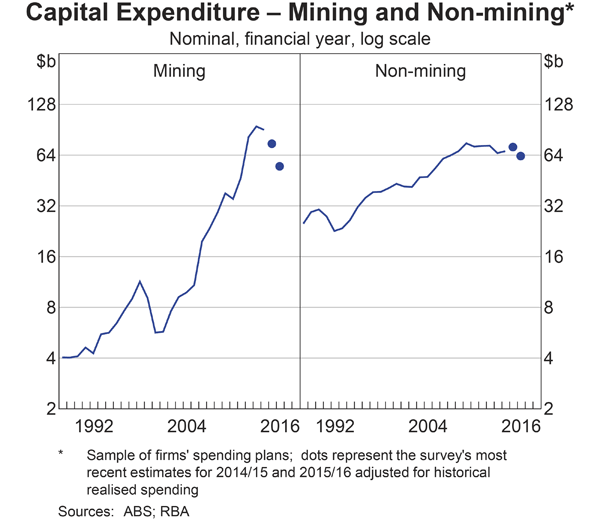
On the other hand I've also been looking at what's been happening to Australia's GDP: the graph below comes from the Reserve Bank of Australia's excellent Chart Pack, which is a very handy guide to the Aussie macroeconomy.


This looks very much like a gradual long-term deceleration in Australia's growth rate, and at first I thought it might have been due to the winding down of the resource project boom. But the timing is all wrong for that as an explanation: in fact, the mining investment boom did not get properly underway until around 2000, and did not peak until 2012-13. In fact the slowdown in overall GDP growth happened despite the substantial boost to activity from the mining sector.


There's been quite a bit of debate about whether developed countries are looking down the barrel of slower economic or productivity growth in the future: it's been a particularly big issue in the US and UK, where recent productivity growth performance has been very weak. Until I looked at these graphs, I hadn't really expected the Lucky Country to be in the frame as well.

Thursday, April 16, 2015

How do supermarkets compete?

In the previous post I wrote up the results of the Electricity Authority's latest survey of competition in various industries: supermarkets came out tops in terms of people's assessment of whether they are getting a competitive deal from businesses they deal with. While it wasn't a full economy-wide survey, and maybe there are unsurveyed sectors that would have shown up better than the supermarkets, it was nonetheless very interesting that people feel they are getting a fair deal from supermarkets vying for their custom, and all the more so because there have been concerns about a potential duopolistic shakedown.

As it happens, I just came across another new survey which tells us in more detail what people value from supermarkets (it's Australian, but I'd suggest it's equally applicable here). It comes from Roy Morgan Research's 'Single Source' surveys, which are very large scale: this supermarket one had close to 16,000 respondents, all interviewed face to face. The press release is here (the full thing costs serious $, which is fair enough given the scale and value of the exercise).

Here's the core result, where we can see the various dimensions across which supermarkets compete, and which ones most press consumers' buttons.


Before seeing these results, I'd have guessed that some dimension of all-in-one convenience would have topped the list, supermarkets being (you'd think) the classic economies of scope/minimise transactions cost model, but I'd have been wrong. There are, to be sure, some convenience dimensions in the most valued characteristics of a supermarket. And there are some price/value dimensions, too, which you'd also expect to be high up the list. But the surprise packet - for me - was the very high ranking of quality, with 'high standards of food safety', 'hygienically prepared food', 'good quality' fruit and veg and 'clean and tidy' taking four of the top nine spots, including the top one itself.

Apart from its intrinsic interest, and the insight it gives into the real nature of the supermarkets' value proposition (and, I'd guess, a glimpse of their likely strategic thinking), it's a good reminder that competition is more than competition on price. Sure, most of us involved in thinking about competition have taken the idea on board, most of the time, and there's even an acronym SPQR (Service, Price, Quality, Range) that people sometimes deploy to make sure they've got all the potential bases of competitive rivalry covered. But it's nonetheless easy to lapse into using price as a proxy for everything. In some lines of business, and supermarkets are clearly one, that could lead you badly astray, and in several directions. You could easily assume there is less competition that there actually is. And, if rivalry diminished on one of those non-price dimensions, you could easily miss that, too.

Monday, April 13, 2015

Are we getting a competitive deal - 2015 version

The Electricity Authority has done everyone a service. It's just come out with its latest surveys of the state of competition in the electricity industry and - because it needs to know whether the level of competition in electricity is good, bad or indifferent compared to other industries - in a range of other sectors. It's got two surveys, one of the general public and, if you're into electricity, one of stakeholders in the electricity industry. These surveys are a great thing to do, especially as they are now beginning to develop a bit of history: when I first wrote about them, there were only two surveys' worth of data, but now there are four, and we can maybe start to see patterns over time.

Here's the key graph from the survey of the public, which shows people's responses to the question, "Using a 0-10 scale where 0 means not at all competitive, 5 means just adequate and 10 means extremely competitive, how competitive are the following businesses in terms of working to get your business and offering you the best deals? If you do not know enough, just say so".


It's hard to know which of these results is the most intriguing. The ranking of industries is interesting: for all the concerns expressed about our supermarket duopoly, consumers evidently feel that it's a competitive one, with the the two of them duking it out in the marketplace, and they rate the deal they're getting ahead from the supermarkets a little bit ahead of the others in the survey. The low ranking of online bookstores, by the way, is because there's an unusually high proportion of 'don't know' answers, which kind of surprises me as I'd have reckoned anyone buying a book these days must have given the offshore services  a go by now, but there you are. If you're interested in the minutiae of the poll results, I've out a detailed table at the end of this post, 'over the fold' as they say.

The most recent trend, admittedly on this short series, is a little bit of a worry: except for petrol stations, the trend over the past year has been for the degree of competition to ease off a bit. Perhaps in the currently strong economy, sellers don't feel they have to compete quite as hard to earn a crust? As for petrol stations, while I'd generally go on the assumption that people are perfectly capable of making good judgements about suppliers and the deals they're offering, I'm not sure in this particular case whether motorists have been able to separate out how much of lower prices is due to lower import costs and how much to any increased intensity of competition (you might be interested in my earlier post about what's happening at the petrol pump).

These are great surveys: full marks to the Electricity Authority for running with the idea. It does, naturally, raise the question why the Commerce Commission isn't doing the same across a wider range of sectors. As I've argued before, "I reckon it's time for the Commerce Commission to belly up to the bar and tell us what real differences [in levels of competition] are happening in our markets".

And if they don't, or can't, or won't, maybe we should pirate one of the recommendations of Australia's Harper review of competition policy (if you haven't caught up with its excellent work, start here or go to the thing itself). It argued (in Recommendations 43 through 47) for a new pro-competition advocacy body, an Australian Council for Competition Policy, that would among other things "develop an understanding of the state of competition across the Australian economy and report on it regularly" (p76). It's a good idea, and we should steal it.

Finally, for anyone who wants the more detailed responses, here they are.


Sunday, April 12, 2015

Australia's got the competition gospel. Have we?

At the end of last month Australia's 'Harper Review', or more formally the Competition Policy Review, issued its final report (where there are links to the chapters, the full report, and, if life's too short, a series of cheat sheet infographics which will give you the guts of the thing). I'd loved its draft report when it came out last September: it was a breath of fresh air to find a review body that was systematically on the side of the benefits of competition and against the privileged interests created, for example, by restrictions on parallel imports. In particular I'd liked its proposed change to s46 of Australia's Competition and Consumer Act, which is the equivalent of s36 of our Commerce Act, the bit that deals with misuse of a substantial degree of market power, and I was very pleased with its forthright stance against creating "national champions" shielded from domestic competition.

And there was also a whole bunch of other worthwhile stuff dealing to impediments to competition, notably (I'm quoting from the relevant cheat sheet) removing regulations that inhibit competition in areas such as aviation, shipping and taxis, and dealing immediately to archaic anti-competitive arrangements by reforming retail trading hours, parallel importing, and pharmacies. Predictably the pharmacists have responded with the usual special pleading, but there was an excellent riposte by the University of Melbourne's Prof Philip Clarke which said among other things that "the lack of competition in the sector comes at a cost to the consumer, both in terms of the choice of where they can shop and in the prices that must be paid...a packet of aspirin, which may cost as little as $3 in [the] retail marketplace costs up to $12 when it is dispensed under the PBS [Australia's Pharmaceutical Benefits Scheme]".

The final report has a few changes from the draft version (the relevant cheat sheet is here), including a new and sensible recommendation (p51) that "Competition principles, particularly those promoting choice and a diversity of providers, should be incorporated into [government] procurement, commissioning, PPP [Public-Private Partnerships] and privatisation policies and practices" and the equally sensible recommendation that "Non-employment trading restrictions in awards and industrial agreements should be subject to competition laws".

On the misuse of market power, the Review was originally minded to allow a defence that
the prohibition would not apply if the conduct in question would be both:
• a rational business decision by a corporation that did not have a substantial degree of power in the market; and
• likely to have the effect of advancing the long-term interests of consumers
but as the Review notes (p342), "This proposed defence is generally not supported by submissions", including, incidentally, our own Commerce Commission's, and they dropped it. Their final position (Recommendation 30) is
The primary prohibition in section 46 of the CCA should be re-framed to prohibit a corporation that has a substantial degree of power in a market from engaging in conduct if the proposed conduct has the purpose, or would have or be likely to have the effect, of substantially lessening competition in that or any other market.
To mitigate concerns about inadvertently capturing pro-competitive conduct, the legislation should direct the court, when determining whether conduct has the purpose, effect or likely effect, of substantially lessening competition in a market, to have regard to:
• the extent to which the conduct has the purpose, effect or likely effect of increasing competition in the market, including by enhancing efficiency, innovation, product quality or price competitiveness; and
• the extent to which the conduct has the purpose, effect or likely effect of lessening competition in the market, including by preventing, restricting or deterring the potential for competitive conduct in the market or new entry into the market.
This for me is a good finishing point, and I'd like to see MBIE, who are looking at what to do about our s36, adopt it holus bolus and move smartly on.

I also liked the Review's recommendation that the net benefits of its proposals ought to be formally modelled (they suggest, by Australia's Productivity Commission). Yes, obviously, it's rather a heroic exercise, and you'll find a discussion of the issues involved in s30 of the report (from p492 onwards), but where we can, we should all be moving to policy that's based on at least some stab at reasonable numbers rather than on wishful thinking or ignorance. I'd suggest the net benefits of their overall package could be very large: the Review helpfully included (pp497-8) some existing estimates of specific reforms, and they're sizeable. Here are a couple of them:
In respect of parallel imports (see Recommendation 13), the PC [Productivity Commission] found that, in 2007-08, a selection of around 350 books sold in Australia were on average 35 per cent more expensive than like editions sold in the US. In many cases, the price difference was greater than 50 per cent.
In regard to planning and zoning (see Recommendation 9), in New South Wales, a recent study commissioned by the state government into the potential benefits of comprehensively reforming planning and zoning in that state showed net benefits ranging between $569 million and $1,482 million per annum, depending on the reform option considered.
So hats off to the Aussies. They haven't done the political hard yards to implement it yet, but at least they've come up with a terrific blueprint for advancing a more productive, more competitive economy and for dismantling the Olde Spanish Practices that have been rorting Australian consumers.

On the other hand I wish I could see a similar appetite for reform in New Zealand. As I've said before, when another Aussie review also came up with a hatful of competition and regulation reforms, you struggle to see the same issues being treated with the same degree of urgency here at home.

Wednesday, March 18, 2015

We are not alone

We all know that demand for housing in Auckland is high, and supply is scarce. As the Governor of the Reserve Bank put it in a speech in February
Auckland’s housing shortage is estimated to have increased over the past year to between 15,000 and 20,000 dwellings, and the Auckland Council estimates that 10,000 houses a year will be required for the next 3 decades. Residential building permits are currently running at an annual rate of 7,700 – a 70 percent increase over 2012 and twice the 2011 level, but well short of the increase that needs to be sustained over a long period.
What people may not know is that our problem is not unique: Sydney's exactly the same, as a recent report prepared by MacroPlan Dimasi for the Property Council of Australia shows. Here's the guts of the findings, from the Property Council's press release, and the full report is here as a pdf.
  • In the first decade since housing targets were set for councils, they have collectively come up over 51,000 homes short – or 23 percent
  • Annual approvals over the past decade averaged 17002 – against a target of 22,178
  • Against population growth, the annual shortfall increased to 5632 – or 56320 over the decade
  • Population projections show Sydney will need to produce 31,076 new homes each year – but based on the current rate of approvals, the annual shortfall is 14,073
  • Even in the favourable market over the past three years, Sydney has averaged 23,350 approvals per year
  • Only five councils in Sydney are currently issuing enough approvals to keep pace with projected population growth.
 Here's an extract from the key Table 2 in the report which seemed to me to be quite interesting.


While the report, and the Council, are rather critical of local authorities' performance in issuing enough building consents, that doesn't seem entirely fair to me. Look at Canterbury in the table. According to the Great Plan From On High, Canterbury was supposed to issue building consents for 263 dwellings a year (column 1 of data). In the event it actually issued 324 (column 2), and got a gold star for achieving 123% of target (column 3) with 61 more than needed (column 4).

Unfortunately for the Canterbury planning office, however, those damn cussed humans weren't following the Great Plan when it came to deciding where to live. Far more of them were actually living in Canterbury than the Great Plan favoured: ideally there should have been 611 new dwelling projects consented to house the actual inhabitants (column 5). Building consents were 287 less (column 6) than actually needed, or only 53% (column 7) of what they needed to be. So rents and prices soared, and living space became tighter, as people were forced to scrunch up with their families, friends and flatmates. People, in short, didn't want to buy what the Great Plan was selling.

So yes, there is still an issue of local authorities not reacting to the actual demand for housing with enough consents in good time (though to be fair, the likes of Canterbury may well have felt constrained to stick to somewhere in the general vicinity of the Great Plan). And the planning process in Sydney is as rickety and slow and expensive and inconsistent as it is here: if you're into the microminutiae of planning processes the MacroPlan report has some detailed suggestions for improvement on page 28, most of which look as if they would be equally applicable to us, including "A broad scale review of employment trends and new employment needs in conjunction with housing needs — to identify land-use opportunities for housing development such as rezoning disused
industrial lands to residential", and "A more responsive development assessment system that curbs costs and recognises that ‘speed to market’ is crucial".

But there's also the bigger issue of getting a better match between the Great Plans of this world and what people will actually sign up for. I can see value to a Great Plan from a variety of environmental, social and economic perspectives (coordination with infrastructure investment, for example). And no doubt many planners would say that their Great Plan is the end result of extensive community consultation, and at some level is what the people want. Well, maybe. But in Sydney at least - and maybe Auckland planning aficionados will chip in about the situation closer to home - it hasn't turned out that way.

Sunday, December 7, 2014

Let's get more serious about competition

Australia's Financial System Inquiry, aka the Murray report, came out over the weekend: you can find overviews here or here and the thing itself here.

I was particularly taken with the bit that looked at the interplay between regulation and competition: regulation can often have positive results (such as helping with the stability of the financial system) but it can also reduce competition (for example by writing rules that make it harder for new entrants).

The Aussie report, I'm pleased to say, came squarely down on the side of competition.

First it said that
The benefits of competition are central to the Inquiry's philosophy. While competition is generally adequate in the financial system at present, the high concentration and steadily increasing vertical integration in some sectors has the potential to limit the benefits of competition in the future. Licensing provisions and regulatory frameworks can impose significant barriers to the entry and growth of new players, especially those with business models that do not fit well within existing regulatory frameworks
And its Recommendation 30 consequently says that Australia should
Review the state of competition in the [financial] sector every three years, improve reporting of how regulators balance competition against their core objectives, identify barriers to cross-border provision of financial services and include consideration of competition in the Australian Securities and Investments Commission's mandate.
The Murray report comes on the heels of earlier reports from the Aussies' Competition Policy Review (which I wrote about here, here and here) which also put competition front and centre in policymaking: all good stuff.

The recommendation that Australia should look at the state of competition in the financial sector every three years reminded me that in June our Productivity Commission came out with its report on raising productivity in  the services sector, and recommended (as I wrote here) that "The Commerce Commission should be able to undertake studies on competition in any specific market in the economy".

Six months later, nowt. As the Productivity Commission says on the services report website, "The Government is considering the Commission’s report and recommendations. No timeframe has been set for the overall response"
.
You're left with the feeling that the Aussies are taking the benefits of competition rather more seriously than we are.

Tuesday, October 14, 2014

Three decades later, still bonkers

Last week the Australian Productivity Commission came out with a couple of reports, on the Aussie dairy trade (pdf) and on Aussie retailing (pdf). I wrote up the dairy one because it had various angles relevant to us, notably some discussion of our Fonterra-centred industry structure, a good smackdown of the 'national champions' idea, and some useful analysis of the economics of the global dairy trade.

I've only just got round to taking a squizz at the retail report, and it's equally good. It points out, for example, that a lot of planning/zoning regulation can be both inefficient and anti-competitive, and that there's a reasonably straightforward path to fixing both problems:
Two reforms have been identified as being of particular importance: first, the need to
reduce the number of business zones and increase the permissible uses of land (to reduce
prescriptiveness) within these zones; and second, to remove consideration of the effects on existing individual businesses from the approval process for development applications (to avoid anticompetitive outcomes) (p11)
The Commission is strongly of the view that state, territory and local governments can
assist consumers and the retail sector by developing and applying zoning policies that
ensure the areas where retailers locate are both sufficiently large (in terms of total retail
floor space) and sufficiently broad (in terms of allowable uses, particularly those relating to business definitions and/or processes). This would allow new and innovative firms to enter local markets and existing firms to expand (p11)
As an example of how those reforms would work, the Commission had heard submissions about high rents being charged to retail outlet tenants by shopping centre owners, and while it noted that following best practice in leasing wouldn't be a bad idea, it also found that "the root cause of most retail tenancy lease problems are unduly restrictive planning and zoning controls that limit competition and restrict retail space, particularly in relation to shopping centres. Addressing the latter would also resolve many of the problems in the retail tenancy market" (p12).

More generally, the report got me thinking about how far Australia, and New Zealand, have got with pro-growth, pro-efficiency, pro-competition deregulation. Because, as this report found, despite years and years of economic reform, there are still thickets of regulation that are absolutely bonkers.

Three examples. I'll let them speak for themselves, other than to note the Aussie Commission comment (p113) that "In many cases, these [trading] rules are anachronistic and have no apparent rationale".

Here's a map of trading hours regulation in Western Australia (p7, repeated on p113).


And here's a decision tree on whether you're allowed to open for business in Australia on Easter Monday (p114).


And here's what Woolworths discovered about trading rules in Western Australia for its Masters Home Improvement Stores (which are like Mitre 10 or Bunnings Warehouse megastores):
in Western Australia, regulations prevent Masters Home Improvement stores from trading in line with the hours enjoyed by other hardware stores. To be eligible to trade as a ‘domestic development shop’ Masters must only sell those goods that are prescribed by the Retail Trading Hours Regulations 1988. The regulations prescribe a list of what a ‘domestic development shop’ can sell, which gives rise to all sorts of inconsistencies and anomalies. The regulations allow the sale of:
• light bulbs but not light fittings
• outdoor lighting but not indoor lighting
• kitchen sinks but not dishwashers
• wood-fire heaters but not gas heaters
• indoor television antennae but not outdoor television aerials (p10)
I suppose the good news is that both Australia and New Zealand now have Productivity Commissions that are able to turn over the flat stones and tell us what they're finding underneath, and there's the occasional one-off inquiry like Australia's recent Competition Policy Review that has been doing the same thing (have a read here in particular). It's good to know that there's still some kind of following wind to keep the momentum of reform going.

But isn't it strange, and a bit dispiriting, that after the best part of 30 years of progress in both countries, we're still lumbered with this kind of malarkey. And while I suspect we may not be as bad as the Aussies on most shop regulation (though I could be wrong about the  Easter trading, where our regime is probably as chaotic as theirs), I wonder what we'd find if, for example, we turned over some flat stones of our own. I wonder what's underneath the occupational qualifications one?

Sunday, October 12, 2014

Three strikes, and you're - still going....

In a previous post I mentioned that Australia's Competition Policy Review had put a torpedo into the side of 'national champions' - requiring or allowing mass consolidation of an industry to produce what will supposedly be a more internationally competitive player.

And last week, I'm pleased to say, the drifting hulk took another blow as Australia's Productivity Commission got it amidships with another one.

The occasion was the Commission's report on dairy manufacturing (pdf) - the latest in an industry series on 'Relative Costs of Doing Business in Australia'. There's lot of interesting stuff in the report, including the short but informative Appendix B down the back on 'Economics of dairy markets',  but for me the highlights were the bits where the Commission responded to submitters arguing that Australia should go the Fonterra route (these are all on p3):
the Australian dairy industry is a price taker on global markets and has no capacity to alter this, irrespective of the structure of the industry. A belief that any single Australian dairy company could exert market power is not consistent with market realities
the emergence of a dominant manufacturer is not a prerequisite for developing distinctive Australian branding for dairy products
there are potential risks associated with highly concentrated industry structures if the overall performance of the industry is linked with one company
Fonterra-like arrangements are not necessary to ensure that scale benefits at the plant level are realised — indeed, there is considerable evidence that Australian dairy manufacturers are taking advantage of scale benefits where it is profitable
And the Commission wrapped it up on p8 with this:
...industry participants are best placed to balance the various tradeoffs and commercial considerations they face (such as between scale and transport costs). Other than where legitimate competition concerns are relevant...the most beneficial dairy industry structure for Australia will be determined by the market place. Attempts by governments to ‘second guess’ market outcomes to achieve a particular industry structure are fraught with difficulty, and likely to impose net costs on the industry and the community more generally. It does not require much imagination — or experience with price setting by government — to envisage highly problematic judgements in setting an Australian price (or prices) for guaranteed domestic milk supply, as occurs today in New Zealand.
The Commission also quoted (pp115-6) from a recent speech by Rod Sims, the head of the ACCC, where he said:
We are seeing a return to calls for ‘national champions’ in Australia. It is, of course, terrific when companies out compete their rivals and take on the world. The concern is when they call for restrictions on competition at home so they can better compete on the world stage. The argument is a contradiction: if you cannot beat your rivals at home how can you hope to do so overseas? Firms involved in cosy oligopolies or oligopolies in Australia are unlikely to succeed on the world stage.
So it looks as if the old rustbucket SS National Champion has now taken three hits in a row. Unfortunately, if past experience is any guide, it will manage to struggle back to port, get patched up, and in due course set out again on another hopeful journey.

Wednesday, October 1, 2014

No national champions, please

In earlier posts (main one here, follow-up here) I've commended the wonderful work done by Australia's Competition Policy Review. They've systematically taken a pro-consumer, pro-competitive approach without wandering off piste into anti-business populism.

They didn't get stampeded, for example, into "doing something" about the concentrated Aussie grocery business, noting that "While concentration is relevant, it is not determinative of the level of competition in a market...competition between supermarkets in Australia appears to have intensified in recent years... consequently, few concerns have been raised about prices charged to consumers by supermarkets" (p181). If there are issues of the big supermarkets strongarming their suppliers ("unconscionable conduct" in Aussie competition-speak), well they are before the courts, "where they are best considered" (p182). And if the arrival of the big chains tended to deal to the traditional mom-and-pop high street shops, "Undoubtedly these changes can damage individual businesses. However, consumer preferences and choice should be the ultimate determinant of which businesses succeed and prosper" (p183), and "While the Panel is sensitive to these concerns, they do not of themselves raise competition policy or law issues" (p184).

Along the way I wrote about some of the ridiculous anti-competition regimes that the Policy Review uncovered - notably Western Australia's bizarre potato regulations and New South Wales' monopoly organisation of the rice market, and I had some reader feedback that perhaps here in New Zealand we weren't much better, given the way we've allowed the creation of Fonterra.

As it happens, the Aussies looked at the "national champion" issue, too, and again took the pro-competition road. They had a bit (Box 15.1 on p196) specifically about Fonterra, and said that it wasn't in fact the kind of "national champion" monopolist that some Aussies were promoting. "The [Fonterra establishment] legislation included provisions and obligations on Fonterra designed to provide for domestic competition and prevent harm to consumers and farmers as a result of the merger. Concerns were raised that the farm-gate price would be depressed due to Fonterra's dominance as a buyer. These were addressed through a combination of regulation and incentives...To achieve domestic competition in the sale of milk products Fonterra had to divest several brands to competitors and is obligated to supply them on competitive terms". And they quoted Bill English as saying, "Sometimes they think in Australia that we've got a monopoly and it works, but we don't and having one doesn't".

Then they turned to the general issue of whether creating "national champions" is a good idea, as there's always someone lurking with a cunning plan along those lines (our meatworks industry is a plausible candidate for the next one). As far as I'm concerned, these next couple of paragraphs (from p195) ought to be carved in stone and erected outside any government departments or agencies thinking about going along with a bit of "national champion" industrial planning. The added emphasis is mine.
From time to time there are calls for competition policy to be changed to allow the formation of ‘national champions’ — national firms that are large enough to compete globally. While the pursuit of scale efficiencies is a desirable economic objective, it is less clear whether, and in what circumstances, suspending competition laws to allow the creation of national champions is desirable from either an economic or consumer perspective.
Porter and others have noted that the best preparation for overseas competition is not insulation from domestic competition but exposure to intense domestic competition. Further, the purpose of the competition laws is to enhance consumer welfare through ensuring that Australian consumers can access competitively priced goods and services. Allowing mergers to create a national champion may benefit the shareholders of the merged businesses but could diminish the welfare of Australian consumers.

Sunday, September 28, 2014

A meeting of minds

Last week Australia's Competition Policy Review came out with its excellent draft report (report here, my high level reaction here).

I said I'd come back to some specifics in the report, and there's one in particular that stands out as relevant to us here in New Zealand - and that's the Review's conclusion on s46 of the Aussie Competition and Consumer Act (CCA), which is the equivalent of  s36 of our Commerce Act. Most people following this blog won't need a refresher on what s36 is, but just in case it's the bit in our Commerce Act that says
36 Taking advantage of market power
...
(2)A person that has a substantial degree of power in a market must not take advantage of that power for the purpose of—
(a) restricting the entry of a person into that or any other market; or
(b) preventing or deterring a person from engaging in competitive conduct in that or any other market; or
(c) eliminating a person from that or any other market.
The thing is widely seen as a waste of space as it stands, partly because of the language of the section, partly because of how the New Zealand courts have interpreted it, and all against a background of being an intrinsically difficult thing to police in the first place.

Earlier this year our Productivity Commission, in chapter 7 of its report on Boosting Productivity in the Services Sector (available here), said (p135) that "The Government should review section 36 of the Commerce Act 1986 and its interpretation", that "The review of s 36 should take account of the review of competition policy in Australia, with a view to achieving a consistent approach", and that
The review of s 36 should include consideration of the merits of:
 a more flexible approach where courts do not rely on a single counterfactual test for
an abuse of monopoly power [this is a reference to the, shall we say, idiosyncratic approach of the New Zealand courts];
 more of an “effects” approach to gauge whether conduct has harmed dynamic
efficiency, and
 providing for an efficiency defence in cases where the conduct of a firm with substantial market power fails a primary test that it is harming competition.
Lo and behold, that's pretty much exactly where the Aussies have fetched up.

They agree that the language of the section is off kilter, for two reasons.

One is that "take advantage" bit: as they say (p208), "Both the courts and the legislature have wrestled with the meaning of the expression ‘take advantage’ over many years. Its meaning is subtle and difficult to apply in practice".

And then there's the wording of the "purpose" bit. As the Review says (p210),
Presently, the purpose test in section 46 focuses upon harm to individual competitors — conduct will be prohibited if it has the purpose of eliminating or substantially damaging a competitor, preventing the entry of a person into a market, or deterring or preventing a person from engaging in competitive conduct. Ordinarily, competition law is not concerned with harm to individual competitors. Indeed, harm to competitors is an expected outcome of vigorous competition. Competition law is concerned with harm to competition itself — that is, the competitive process.
So they've suggested (p210) skittling "take advantage" completely - excellent - and rewriting the rest of it with more of an "effects" approach (as our Productivity Commission suggested was worth looking it) so as
to prohibit a corporation that has a substantial degree of power in a market from engaging in conduct if the proposed conduct has the purpose, or would have or be likely to have the effect, of substantially lessening competition in that or any other market
As they say, do that, and then s46 becomes
the standard test in Australia’s competition law: purpose, effect or likely effect of substantially lessening competition. The test of ‘substantially lessening competition’ would enable the courts to assess whether the conduct is harmful to the competitive process
And finally they've come up with much the same sort of backstop defence for a business that our Productivity Commission flagged, namely
the primary prohibition would not apply if the conduct in question:
• would be a rational business decision by a corporation that did not have a substantial degree of power in the market; and
• would be likely to have the effect of advancing the long-term interests of consumers.
The onus of proving that the defence applied should fall on the corporation engaging in the conduct
Currently MBIE are beavering away in the background on a review of s36, after their Minister, Steven Joyce, picked up on the Productivity Commission's recommendation to have a rethink.

Save the time and money. I say we send the Aussie Review members a thank you note and a couple of cases of our best Pinot Noir, declare victory, and go home.