Showing posts with label telecoms. Show all posts

Monday, May 30, 2016

The state of telco play, 2016

The Commerce Commission's latest annual report on the state of our telco markets came out last week. At the time I was too busy on other things to give it a good read - and if you're also up to your eyes, then there's a media release and a cheat sheet infographic to give you the gist - but I've now got round to it and, like the previous ones, it's well worth a look (my comments on earlier ones are here and here).

Before getting into some of the details, I'll just say - again - that we have a daft system for regulatory review of what's happening in our markets. The Telecommunications Commissioner, who is part of the Commerce Commission, is required to conduct and publish reports on what's going on in telco markets (under s9A of the Telecommunications Act 2010), but the Commerce Commission itself is forbidden to do it in any other markets (under the courts' reading of the Commerce Act). There are people in the bowels of MBIE looking at the discrepancy at the moment: let's hope they come down on the sensible side of the fence.

And there's a good example in this latest report on how proactive enquiries into the state of competition might work. The report was looking at market shares in the mobile market (p36):
We have noted 2degrees’ very small share of business market revenues in prior reports. We commissioned UMR to undertake a survey of the business mobile market in the latter half of 2015 to gain a better understanding of the market and check if there were any barriers to expansion. Overall, the survey revealed no evidence of anti‑competitive behaviour.
Excellent - the Telecommunications team found something odd that might have been an issue with competition, investigated it, and was able to blow the All Clear. Exactly what should be happening in every other sector of the economy.

This year's report is mostly a record of solid, ongoing progress in the sector, with greater uptake, faster speeds, decent levels of consumer choice, and somewhat lower prices (more obviously lower when quality-adjusted). Your interests may be different, but here are a few thoughts that occurred to me.

This is the graph showing how broadband download speeds have been improving.


All well and good, but the set of comparators looked a bit idiosyncratic. Where are the smaller OECD economies like Denmark or Ireland or Switzerland that we might normally want to match ourselves against? And why Malaysia, of all places? So I went to the original Akamai report these numbers came from, and I was able to find a table of download speeds for a wide range of Asia-Pacific countries (including us), and also a table of European speeds.


By Asian standards, we're doing pretty well, especially when you consider that some of the very densely urbanised countries like Korea, Hong Kong and Singapore must be a good deal easier to serve, compared to us having to trench our way up the Cobb Valley. But by European standards, we're not such hot stuff, even when compared with long, skinny, thinly populated places like Norway and Sweden which must have similarly challenging geographies.


If we were a European country, we'd rank only 21st on that table (behind Poland, ahead of France). And globally we rank 41st in the Akamai universe - not so flash. We'd expect to be somewhere in the top 20 on most other economic measures (the other day we came 16th in the latest World Competitiveness Rankings, for example). So by all means let's be happy that speeds have improved, but also let's be aware that we are (for whatever reason) still well behind the sorts of speeds our kids on OE can get (unless they're in Australia).

There was also a fascinating chart showing the extent of pent-up demand in New Zealand for decent online content, after years of limited choice, long delays, and high prices. The little arrow on the chart shows the immediate and ongoing surge in data consumption when Netflix arrived. I can only begin to imagine the existential angst in the strategic planning units of our telco and media companies: some current business models can't hold.


Finally, on the regulatory front, the report noted (p30) that
The wholesale cost of terminating a phone call on a mobile network is called the mobile termination rate and is regulated in nearly all countries. We last reviewed the mobile termination rate on 5 May 2011, and the last regulated reduction prescribed in that determination was to 3.56cpm (excluding GST) on 1 April 2014. The ACCC last year set the mobile termination rate for Australia at A1.7cpm, and as at July 2015 the weighted average for Europe was 1.22 eurocents per minute.
There is no obvious reason why our mobile termination rates should be well in excess of those overseas - at current exchange rates, roughly twice Australia's, and roughly 75% higher than Europe's. The technologies are the same, and on some opex costs we should be cheaper (our wage bills are lower, for example). I'm no great fan of extra regulation, and still less of extra price control regulation, but if the subtext of "We last reviewed the mobile termination rate five years ago" is "And, you know, it's about time we had another look", I reckon the Telecommunications Commissioner is on the right track.

Thursday, April 14, 2016

The future of telco regulation

No doubt you've seen all the coverage of the government's high level decisions on regulation of the telco sector from 2020 onwards (if not, the media release is here, the once-over-lightly summary is here and if you want to mainline the hard stuff go here).

It's a good set of decisions, though a lot of detail is yet to come, and there'll be another round of consultation on options. The big (and expected) decision is that both fibre and copper based internet services will be regulated as utilities, in much the same way as electricity lines businesses are today. That changes the way copper based internet is priced today, and properly so - as I argued here, the 'TSLRIC' model for pricing copper was good for one purpose (enabling efficient competitors to get into the game) but not adequate for regulating a copper provider's above-normal profits.

The media reaction is all over the new 'utility' model. But there's one part of the decisions that hasn't been picked up much, and here it is:
However, there is also the option for a more light-handed ‘backstop’ regime. The threat of regulation combined with requirements to release financial and cost information could work as an effective incentive to keep prices at reasonable levels. While this isn't the Government’s preferred approach at this time, we will be interested in discussion on this point. 
I think this is an option that should be explored further. I'm not sure that an information disclosure plus hidden knuckleduster regime would cut it on its own - it might, and maybe existing practice could be strengthened, but the precedents to date aren't great - but there very badly needs to be some intermediate, simpler, faster, less complex and less expensive alternative to the 'building block' model of utility regulation that's being proposed.

The regulatory regime would be much better if, for example, there was an 'RPI minus X' option somewhere along the way - where suppliers are allowed to raise their prices by the Retail Price Index (this is UK terminology originally, so that would be our Consumer Price Index), less some amount 'X', a plausible enough guess at what sort of productivity and efficiency gains the supplier can wring out of the business.

There's nothing inherently wrong with the 'building block' approach. Arguably, it gets closer to a supplier's 'true' costs and profits than anything else. Applied fairly and consistently, it can form a good basis for an effective regulatory compact between regulator and regulatee, and can protect consumers from profiteering. But as anyone who's had anything to do with the process knows, it's a beast of a thing to construct and maintain (or even understand, in its thornier thickets). If we end up there, we end up there, but we should really put some serious effort into intermediate or alternative options - particularly as, at some point, we as a four and a half million people economy ought to start using more "cheap and cheerful" policy regimes, rather than the industrial strength superstructures a US or a UK can afford.

A final comment: the government is keen on keeping competition up to the mark in the mobile market, and is thinking about things like mandating the price competitors pay to access incumbents' mobile towers. And it said
We will consult further on encouraging sharing of infrastructure, and making sure the Commerce Commission has the tools it needs to investigate the market.
I'm hoping the last bit of that sentence means that the government is finally getting its head around the desirability of the Commerce Commission being able to have a proactive look at the state of competition in any given market - a "market studies" power, in the jargon. I've been banging away at this for ages - my latest efforts are here and here - as have others (notably our Productivity Commission). Hopefully this latest telco exercise has finally nailed the absurdity of the country's competition watchdog not having the legal authority to do a key element of its job.

Wednesday, February 10, 2016

No appeal? Good

I've been catching up with stuff that's happened over the summer holidays, and I have to say I was quite encouraged when I found out that Chorus has decided not to appeal against the Commerce Commission's decisions on copper broadband pricing and on backdating the regulated price.

Chorus's statement on January 28 said that "the Chorus Board has elected not to appeal the decision, despite disagreeing with some key elements such as the lack of backdating. While we are aware that some investors feel there may be merit in further testing aspects of the determination in court, it is the strong view of the Board and Management that the best long-term value for our shareholders and customers will be achieved through the industry focussing on bringing New Zealand better broadband".

Well said. Even if there is also something of a Mexican standoff going on - "we won't appeal against some aspects of the decisions if everyone else holds off, too" (my words, not theirs) - the general idea is bang on the button. There has been a deal of opportunistic regulatory and litigatory rent-seeking in the telco, and other, sectors over the years, and it is good to see someone turning their back on it and getting on with running the whelk stall.

More companies could usefully realise the true extent to which regulation and litigation are a distraction from their core lines of business. The direct costs of management and board time, and of lawyers and economic experts, are only a fraction of the true cost of diversion of focus from longer-term performance. In my experience, across various governance roles, that item on the agenda about the regulator or the court case takes on an entirely disproportionate importance. The corporate ego gets overinvested in winning: business strategy and longer-term performance are the inevitable losers.

Chorus may well have come to another correct conclusion that others could learn from: if you play the regulatory game too hard for too long, it will bite you (as I've argued before). We might eventually have had sector-specific regulation in any event, but there's little doubt that Telecom (as was), and various parties in the electricity business, pulled their current sectoral regulatory regimes onto their own heads through their bloodyminded intransigence.

I'm perfectly happy to accept that focussing on the business was the primary motivation for Chorus flagging away any appeals.  But if in the background Chorus also reasoned that pushing their luck on backdating - they might have scooped a pot of some $140 million - on top of a halfway decent outcome on the price, would have been a bad strategic move, given that the whole regime of telco regulation is currently under review, then they made a good call.

Thursday, June 11, 2015

What's happening in the telco sector

Earlier this week the Commerce Commission came out with its latest Annual Telecommunications Monitoring Report (pdf), and very interesting reading it was, too (as was last year's, as I commented here). In passing, it's daft that the Commission is obliged to report on the state of competition in the telco markets, while it is not allowed to publish proactive reports on the state of competition in the rest of the economy. If you're interested in the whole 'who can report on the state of competition' and 'market studies' issue, I'll be talking about it at this year's New Zealand Association of Economists annual conference - full programme here.

Back to the report. Lot of things to like by way of positive developments in the sector, though there is still quite a flavour of the deadweight legacy cost of the copper network, and the Commission's likely reduction of the copper price next month will be a positive move. In particular among the positives, consumers are mostly getting better value for mobile services: as the two graphs below show, mobile bundles are competitive by international standards, and prices have been falling.


But there are some oddities even on the mobile side. When you see the table and graph below you have to ask, why the very expensive prices by international standards for slugs of mobile data, and why aren't they falling, too?


I don't have any good rationale for this and neither does the Commission: on static prices, it comments (p33) that "This suggests there is a lack of demand for and/or competition to supply mobile broadband data when it is not part a bundle of mobile phone services, particularly when it is a relatively large amount of data". Don't know about lack of demand - you'd think there are plenty of people running around these days with lots of uses for their tablet-style devices - and you'd think mobile companies would compete harder for this upmarket business. Odd.

Apart from the prices, usage, revenue and investment sort of stuff, the report has heaps of other interesting stuff. For example, did you know this (below) about the percentage of our students who are taking computer science courses?


There was one pair of graphs which I had some difficulty with. I'd like to believe this one, which shows we're right at the head of the international pack for the proportion of businesses selling over the internet...


...but I can't square it with this one...


...which says that only 11% of small businesses make sales over the net. If (conservatively) you say 80% of all businesses are small businesses, you can't get to the national 47-48% figure of the first graph.

Never mind: this is still an excellent resource. As well as all the obvious stuff, it's also got a very useful chronology of events in the sector over the period January 2014 to March 2015: if, like me, you have to go away and look up things like the sequence of draft copper loop pricing decisions, it's all there in one convenient spot. 

Monday, March 9, 2015

There has to be a better way. And there is

I'm convinced there's a better way to get a good fix on some of our more contentious, and important, regulated telecoms prices. Let's deal to some jargon first, and then we'll get properly underway.

If you've got broadband, you get it from an Internet Service Provider (your ISP). And chances are it arrives over the copper wire phone line to your house. You could be on wireless broadband, or you might have signed up for the flashy new fibre network that's being rolled out, but most of us are still on the old copper based system. It's owned by Chorus, and your ISP pays Chorus for the use of that copper line from your house to the nearest telephone exchange. That service is known as the Unbundled Copper Local Loop, or UCLL. ISPs can put their own equipment in the exchange and take the feed from there, or they can rent some gear from Chorus instead of providing their own: that's the Unbundled Bitstream Access service, or UBA.

And finally - and this is where things come closer to your wallet - you've likely noticed that your ISP has said it'll be raising its price to you by $4 a month or so, because the Commerce Commission, which regulates the copper line UCLL price, is in the process of raising it from $23.52 a month (its first stab at the right price to charge) to $28.42 a month (its estimate after going through a full cost modelling exercise).

There's a consultation process going on before the Commission's proposed UCLL goes final (all you can eat here). As part of that process, Spark has come up with this graph, which shows how the Commission's proposed price compares with the price charged for the same service in a range of other developed countries.


You may have seen this already - the Herald's technology columnist, Chris Barton ran with it in a recent article, "Something rotten in our Commerce Commission", where among other things he concluded that "by a curious combination [of] free market ideology and caving to political pressure, it's [i.e. the Commission is] promoting monopoly power and a haughty "let them [the end-users] eat cake"." No doubt the Commissioners sacrifice children to the Great Werewolf, too.

In any event the graph does give you pause for thought about various aspects of how telco prices are set by regulation. My main point: I think there's greater room for using information on overseas prices as a guide to setting our own.

We do it a bit, at the moment: that "first stab" the Commission had at setting the price was required, under our Telecommunications Act, to be set by "benchmarking" against prices overseas. Unfortunately the benchmarking was tightly circumscribed in the Act, and had to be "Benchmarking against prices for similar services in comparable countries that use a forward-looking cost-based pricing method".

You can understand the logic. You wouldn't want prices to be set here solely on the basis of countries that weren't at all like us (eg a highly dense conurbation like Hong Kong), hence the "comparable" test, and you wouldn't want prices to be imported into New Zealand that had all been plucked out of the air on some cockamamie basis. And that's a real risk: regulatory proceedings can easily get captured by one vested interest or another. Money politics can see incumbents' prices set on too-favourable terms; populist politics can set prices that don't cover incumbents' costs. So you can see why the legislation saw fit to use prices only if they were set in a particular way.

Trouble is, you can take intellectual purity too far. After filtering according to the Act,  the latest benchmarking exercise, for the UBA service, ended up with only Denmark and Sweden to look at, which left everyone feeling a bit uneasy. I doubt if even the framers of the Act would have liked a benchmarking process that featured only two smallish Scandinavian countries.

So why don't we take a different tack? Why don't we go the Spark route, and look at the whole range of prices overseas? It would make sense to keep some element of comparability, so we might want to restrict it to say the OECD countries, but even that would leave us with a largeish group of 33. Some prices may well be off, and unfairly tilted towards suppliers or consumers, but on average you'd be inclined to think that the truth will appear somewhere in the middle. You might worry that New Zealand has got some special features that make it impracticable to compare with the average overseas experience: people like to raise the "long and stringy" argument, for example (though you'd think places like Norway and Sweden are much the same). All I can say is that I've seen a lot of folks argue both sides of the "New Zealand is unique" case, and I still don't see a knock-out case for our conditions being completely idiosyncratic.

Regular readers - God bless both of you - will know that I've banged on before (for example here and here) about using benchmarking more extensively in our price regulation, and I'd like to see our revised telco regime, when it eventually materialises, reaching more often for the regulatory equivalent of Number 8 fencing wire. It may be low tech, but it's admirably cheap and serviceable.

Tuesday, December 2, 2014

Move along, folks

So here's where we've got to with the wholesale price of internet services.

Internet service providers (ISPs) used to buy access to Chorus's copper lines and electronics for $44.95 a month.

This price was too high and insupportable, and everyone knew it (including Chorus, if it's being honest).

And sure enough it's just been lowered by the Commerce Commission, to $38.39.

Good outcome? You'd think so.

But.

Chorus isn't happy. It didn't want it lowered, or at least by not that much.

ISPs aren't happy. They wanted it lowered to closer to $34.44 (the Commission's estimate of the same price overseas).

TUANZ says the ongoing uncertainty over the price is "disappointing".

Could everyone get a grip, please?

Chorus should be happy. It wasn't knocked back all the way to $34.44.

ISPs should be happy. They're getting a too-high price fixed for them - maybe not pushed as low as they'd like, but hey, this is where the technical experts say it really should be.

The government should be happy. Copper prices aren't undermining uptake of the new fibre network the government is subsidising as much as they might have.

Consumers, and TUANZ, should be happy. They've had the reduction in the price already passed through to them in better value broadband plans (if you believe the ISPs), but in any event it should reach them one way or another.

So there are two ways forward.

One is take to the mattresses in another round of rent-seeking from the regulatory process - submissions, counter-submissions, legal challenges, appeals, smoke, mirrors, subterfuge and artifice, enriching only the lawyers and the specialist economists in a negative-sum game.

And the other is to acknowledge a deal that more or less works for everyone, and get the hell on with doing what the various parties are supposed to be doing, which is making money for themselves by providing a better service for us, the consumers.

I wonder which will happen?

Monday, December 1, 2014

KISS

This morning the Commerce Commission released the wholesale price Chorus is allowed to charge to Internet service providers (ISPs), and which therefore is the core component of the retail prices those ISPs charge you for your fixed line broadband.

It's made up of two parts, the first being the bit for the cost of the copper line from your place to a Chorus switch (the 'local loop' or UCLL) and the second ('UBA') being the cost of the fancy electronics that Chorus can (optionally) provide to ISPs to save them having to use their own. The local loop bit will be $28.22 a month and the UBA bit will be $10.17 a month, making a total of $38.39. This compared with the previous price allowed, of $44.98.

These prices are based on explicit, detailed and complex modelling of the costs involved, and are intended to replace the interim hold-the-fort prices that the Commission had previously set, based on the cost of the same services overseas in countries who do things much the same way as we do. This 'benchmarking' exercise had set a local loop price of $23.52 and a UBA price of $10.92, making a total of $34.44.

There are all sorts of issues involved here, big and small, affecting everything from the profitability of  Chorus through to uptake of the country's shiny new ultra fast fibre network. And they directly affect you, too: already some ISPs are saying that the drop in the wholesale price (from $44.98 to $38.39) had already been passed on to you, so you won't be getting any further joy out of it.
In any event, I'd like to pick on one small aspect of the process, even though it's largely moot now, and it's about those interim 'benchmarked' prices.

I think they did a good job of providing a quick, cheap and reasonably accurate initial estimate of the eventual wholesale price. They were pretty much spot-on when it came to the UBA part ($10.92 versus $10.17), which is remarkable given that everyone was agreed that the benchmarking process had only a couple of countries overseas to use as sighting shots. And they weren't far off when it came to the local loop component, either ($23.52 versus $28.22) - especially when you consider that the fully modelled cost estimate involves a whole swathe of judgement calls made by the Commission and its modellers, and is not a glimpse into some eternal truth held in the mind of an omniscient Being.

So I'd take two lessons away from this, both involving the KISS principle.

The first is that over the next couple of years we're going to be taking a close look at the shape of our telco regulatory regime, and I'd like to suggest that we keep the cheap and cheerful benchmarking process. It's relatively fast - a particularly important consideration in fast moving markets like ICT - it's relatively transparent, it's understandable, it's relatively cheap, and it's accurate within some rough-and-ready-justice tolerance. I'd go further, and make it harder for parties to invoke the full cost modelling approach, which introduces layers of cost, delay and complexity, and all for a gain in 'accuracy' that (because of multiple modelling options) may be more illusory than real. And in general I'd like to see the 'good enough' option chosen over the one that keeps consultancies on three continents in business.

The second is that we need to think harder about the increasing complexity and cost of regulation across all sectors, and not just the telco business. I agree with Eric Crampton of the NZ Initiative, when he said on Interest.co.nz that "Too much of New Zealand’s regulatory apparatus would suit a country of forty million rather than the one we have". He's got his own examples: one I came across recently was the Commerce Commission's needing to sign off a $3 million increase in capex spending on a little Transpower project in South Canterbury. The process will take five months from start to finish, and has already spawned a 54 page initial draft decision.

That's a bit of an extreme example, and I should make it clear that it's not the Commerce Commission's fault: it's been lumbered with this ludicrously over-engineered regulatory regime. And I should add that from next April the Commission won't have to get out of bed for anything under $20 million - which is, of course, where the threshold for its involvement should have been in the first place (if not higher again). And I'd have to note that bloodymindedness on the part of Transpower and its customers drew this intrusive regime on their own heads, and a bit of enlightened give and take could have avoided the whole mess.

But it's there now, and it's holding up the sector, and its cousins in other sectors are also increasingly clunky and costly. It's time for more people in the policy analyst community to do what the MD of one company I know used to do: hold up the sign that says, "Does it make the boat go faster?"

Thursday, September 25, 2014

We need more cables

Earlier this month the World Economic Forum came out with the 2014-15 edition of its Global Competitiveness Report (you can find a link to downloading it here). It got a bit of media attention at the time, mostly on somewhat invidious chauvinist grounds - we moved up a notch, and the Aussies moved down one.


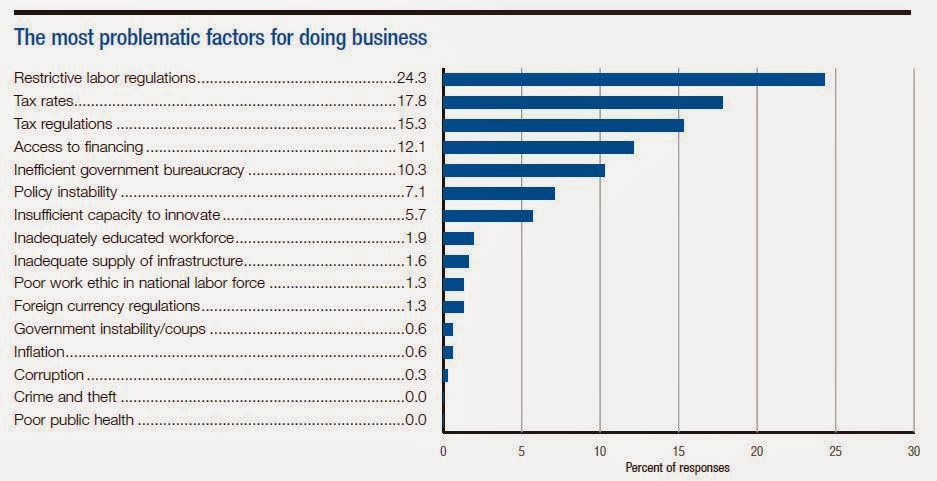
Other than that, the detail didn't get much of an outing over the mainstream media fences, and that's a shame, because the report is full of interesting comparisons, which make for suggestive diagnostic policy tools. Here, for example, is what our business community rates as the main problematic factors for doing business.


This is an interesting diagnosis, especially as it's not the sort of clichéd grumbling you might expect from a business group. In fact, these surveys seem to be pretty accurate around the world. The equivalent French survey, for example, came up with this - quite a different set, and one that looks absolutely on the money.


Coming back to the 'Inadequate supply of infrastructure' theme, here's something that I found disconcerting.

By way of background, the Report covers three groups of things for each country - the essentials; things that make the country work better ("efficiency enhancers"); and things that enable you to compete in the deep end of the international swimming pool ("innovation and sophistication factors"). Those "efficiency enhancers" are made up of six "pillars", one of which is "technological readiness", and which in turn has seven components. Here's how we stack up (score and relative world ranking).


We scrub up reasonably well on technological readiness overall. Indeed, two of them (9.02 and 9.07) count as relative advantages for us, as we do better on those criteria (11th and 14th internationally) than we do on our overall competitiveness (17th). 

But there's one big exception, 9.06: the size of our physical internet connections to the rest of the world let us down badly. And if you want to see how badly, here are the countries most like us on the criterion of available international internet bandwidth*.


From the point of view of sophisticated economic development, this is not the sort of company we should be keeping.

So my thought is, the sooner someone can lay pipe in competition with Southern Cross, the better.

*Note A fair amount of the Report's data is based on subjective 1 - 7 sorts of scales. Not this bit. The definition (from p543 of the Report) is "International Internet bandwidth is the sum of capacity of all Internet exchanges offering international bandwidth measured in kilobits per second (kb/s)" and the source is International Telecommunication Union, World Telecommunication/ICT Indicators 2014 (June 2014 edition)