Showing posts with label markets. Show all posts

Thursday, July 14, 2016

Get your views in on abuse of market power

Right - you've got till 5.00pm next Thursday, June 21, to get your views in to MBIE on their targeted review of the Commerce Act.

It's important, and while I know we've all got other things to do, you'd be doing the economy a favour if you took some time out this week-end (when you're not watching the Warriors take on Manly in Perth, 7.30pm Saturday) to make a submission, particularly on our current approach to abuse of market power - the infamous section 36 of our Commerce Act.

All the background and how to submit can be found here. While technically MBIE is calling for 'cross submissions' on earlier input, anyone can put in something from scratch, though for good form you should probably phrase it as being a response to something already on the record.

There are three issues being canvassed, one big, one medium, one small.

The big one is potential reform of s36, the abuse of market power provision of the Act. In my opinion, and others', the thing is banjaxed. The law is poorly designed, has been interpreted strangely by the courts (both the old UK Privy Council and our newer Supreme Court), and in practice allows behaviour to go unchallenged that would not be countenanced in jurisdictions with better arrangements.

If all this is news to you, read the paper I gave at this year's NZ Association of Economists' conference, 'Abuse of market power: the end of "make-believe" analysis?'. If you'd like to see opinions saying no, everything's hunky-dory as it is, you'll find them in the original set of submissions to MBIE (try the law firms' ones). Whichever way you go on the issues, get your opinion on the record: these issues are too important to be left to 'the usual suspects'.

My cross-submission (I put in a submission first time round, too) is going to be along the general lines of my recent post on s36, 'The law is an ass', and will say:

  • Our competition authority, the Commerce Commission, has given up on making the current regime work despite having identified instances where it thinks there have been potential abuses of market power that it is unable to address
  • Its Aussie equivalent, the ACCC, agrees with it that our system is munted
  • The law is poorly phrased in the first place
  • Hence and otherwise the jurisprudence on s36 has seen the legislation effectively gutted in all but the most egregiously awful cases. In particular, courts are supposed to ask, would a firm without market power have done the same thing, and if so, the firm with market power is home free. This completely subverts the whole point, that some actions when undertaken by firms with market power have anti-competitive effects
  • The Aussies have, rightly and after a very extensive consultation process, decided to change their law (it's currently similar to ours) for something better
  • When the Aussies change, it will be silly and inefficient to have companies facing different legislative tests on either side of the Tasman, and we should harmonise on the better Aussie approach. Harmonisation is a government priority in any event
  • The arguments against change - broadly in  the categories of 'business certainty' and 'potential chilling effects' - while valid, are not strong.

There are two other issues you might want to look at.

The medium sized one is whether someone - probably the Commerce Commission - should have the ability to go out and proactively look at the state of competition in a particular sector. The short answer to that, is yes, of course it should. If you want a very quick potted summary of the case for, try my post 'The case for market studies - again', and if you'd like something more comprehensive there's my paper at last year's NZAE conference, 'Is the competition toolkit missing its torch? The case for market studies'

The smaller one is around the Commerce Commission's enforcement powers, and especially the 'cease and desist' process. I'm very sympathetic to some kind of quick-response tool for competition authorities, but there are arguments that the current 'cease and desist' process isn't working the way it ought. This is probably one for the lawyers amongst you.

On your marks, get set...

Friday, July 1, 2016

The law is an ass

My paper, 'Abuse of market power: the end of "make-believe" analysis?', drew a good crowd at the NZ Association of Economists' annual conference. That's partly because people like to session-hop at conferences and listen to areas outside their usual specialty - a fair few in the audience were folks who don't usually 'do' competition - and partly, I'd guess, because people reckon it's an important policy issue: markets won't work as we'd want them to, if competition is subverted by players with market power.

From the discussion, it was clear that people were left shaking their heads at the folly of our statutory wording (in s36 of the Commerce Act) and its subsequent jurisprudence in the courts. Very briefly, the folly consists of:

  • statutory wording that looks for a 'purpose' to knacker competition and the 'taking advantage' of market power, but
  • 'purpose' is subjective (barring careless e-mail trails) and often business behaviour has multiple purposes, many benign, which can veil the bad stuff, while 
  • 'taking advantage' has been interpreted by our courts as meaning you're home free if you've done something that a firm without market power would have done
  • which completely misses the point that something done by a firm with market power can have very different effects than the same thing done by a firm without market power, and
  • leads to an examination of what would have happened in a fantasy counterfactual world, and
  • nowhere looks at the important issue of what are the actual or likely effects of the behaviour in the market, and
  • Australia's just come to the view that their regime (very like ours) is not fit for purpose, and 
  • in sum the whole shebang comes close to giving firms with market power a free pass on pretty much anything that isn't the most obvious of rorts.

But you knew that (and if you didn't, there's chapter and verse in the paper).

The reason I'm raising it again is that there's an opportunity for people who may be concerned about the current toothless (and internationally idiosyncratic) state of affairs to do something about it.

Last year, MBIE started a 'targeted review of the Commerce Act', which included looking at the operation of s36. An initial issues paper drew 39 submissions. But now there's an opportunity for cross-submissions: you don't have to be one of the original submitters to get into the fray. You have till July 21 to get any views you've got into the policy pot. Full details of the process thus far can be found here, including links to the previous submissions and the logistics of submitting your own.

I'd emphasise that this isn't an anti-big-business agenda. The primary point here is the proper functioning of markets, for everyone's benefit, businesses and consumers alike. The big loser from anti-competitive behaviour is often other businesses.

In any event, get your views on the record. If you're not in, you can't win.

Sunday, March 1, 2015

What's happening at the petrol pump?

Petrol prices, and petrol profit margins, have been in the news. Labour, for example, wants an inquiry; ACT doesn't; and apparently the AA hasn't been happy about 'miserly' falls in local petrol prices as the world oil price has dropped sharply.

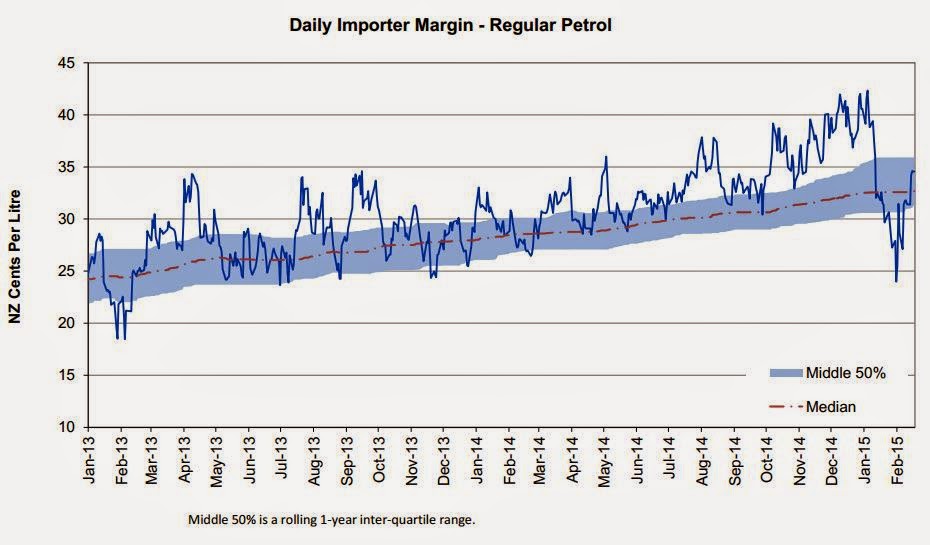
Much of the attention has been based on MBIE's weekly monitoring of 'importer margins', the 'importer margin' being "the margin available to the retailers to cover domestic transportation, distribution and retailing costs, and profit margins". Here's the latest picture, for regular petrol.


As you can see, the importer margin looks to have been climbing over the past two years, from an average of around 24 cents a litre to about 32.5 cents/litre, and on the face of it the rise looks rather dubious: it's doubtful that domestic transportation, distribution and retailing costs have increased much in our low inflation economy, which means the only moving part left is wider profit margins.

I don't know that I'm personally quite there yet with the wider profit margin story, though. For one thing the prices at the pump as measured by MBIE don't reflect the discount you get at the supermarket, and I strongly suspect that those discounts have been rising. For ages our standard supermarket discount used to be 4 cents; then 6, 10 and even 20 cent discounts started popping up (tied to spend); and every other day my phone beeps at me with offers from the petrol companies themselves (the latest was a Caltex Black Caps 10 cents promo on Saturday, which I used). If everyone uses discounts - and they must have become pretty extensive by now - and the typical discount has gone from 4 to 10 cents as (perhaps for valid strategic or tactical marketing reasons) petrol companies have elected to pass on lower costs via coupons and discounts rather than as outright cuts to the pump price you see at the side of the road, then you could arguably explain away a good chunk of the apparent 8.5 cent rise in margins. It's possible too that currency hedging might have produced a higher landed cost for oil than the unhedged estimated price MBIE uses.

If, however, subsequent inquiry shows that the higher importer margin is real, and does not have an arguably competitive explanation, what if anything should be done?

One thing you might be tempted to reach for is some sort of control on the size of retail markups. As a recent paper*, 'The Impact of Maximum Markup Regulation on Prices' (here as a pdf) has said, they have a clear logic: a maximum markup will catch the most egregious profiteers, who will be forced to lower prices, but won't affect those who were able to get by on a lower one.

Or that's the theory, in any event. But when the researchers looked at what had actually happened in Greece when the Greeks did away with the maximum markups wholesalers and retailers could charge on fruit and vegetables, they found that retail fruit and veg prices went down - the opposite of what you'd have expected when the constraints were removed. And by sizeable amounts: the authors found that retail prices dropped by 6-9%. Using the 6% number, the decline "corresponds to a 1 percent decrease in the price of food of a typical Greek household, and a 0.16 percent decrease in the consumer price index. This in turn corresponds to a decrease of €23 in expenditure per capita per year, amounting to €256 million [NZ$380 million] per year in aggregate (about 0.12 percent of GDP)".

Retail prices went down because wholesale prices had gone down, and wholesale prices had gone down because the regulated markups took away "focal points for coordination". You can imagine the discussion in the taverna around the corner from the Athens Central Wholesale Market: "So. Any of us could add on 12%, eh?" "Yup". Thoughtful silence. "Another retsina, anyone?" "Don't mind if I do. Cheers, lads".

There are wider lessons here beyond the price of artichokes in Athens. The big one is that the first best solution to excessive profits is likely to be more competition: in Greece, the wholesale market was "a closed market in which only licensed sellers can operate" and one that had "several features... that make it more prone to collusion (centralized physical arrangement, barriers to entry, limited number of large competitors, daily interaction)". Deal to that, and you're well on your way. And secondly, and relatedly, don't be too quick to reach for a big knobbly stick if you do go the regulation route: the authors say that their work fits with a lot of other work showing that "heavy regulation is generally associated with greater inefficiency and poor economic outcomes". If you're going to regulate, be as smart and light-handed about it as you can.

*It's in an excellent series of discussion papers published by the Centre for Economic Performance at the LSE. The Centre takes an interdisciplinary approach to "the determinants of economic performance at the level of the company, the nation and the global economy", and their output is always interesting. I know, another source of discussion papers will be overload for some - you can already spend too much time at SSRN or at the IZA - but if you've got the time, have a look. Well worthwhile.