Showing posts with label economics. Show all posts

Sunday, July 3, 2016

Book report - July 2016

Although readers (going by page views) seem to like the odd diversion into the world of books, I haven't had the time to do many recent reports, the latest being 'Then and now', my look at the latest volume of Charles Moore's excellent biography of Margaret Thatcher (before that, I'd written up The Fall of the Celtic Tiger, and earlier GDP: A brief but affectionate history and Wellbeing Economics: Future directions for New Zealand).

Now, along has come another great new biography - Volker Ullrich's Hitler, Ascent 1889-1939, with a follow-up second volume in the works. It's both very readable (Ullrich is as much journalist as historian) and professional: Ullrich has gone back to many of the original sources and found new takes on them.  People at every end of the political spectrum have loved it: the Guardian's review called it "an outstanding study" and the Telegraph's review called it "chilling and superb".  Even if you've already read Joachim Fest's Hitler: A Biography and Ian Kershaw's Hitler 1889-1936: Hubris and Hitler 1936-1945: Nemesis, you'll get a lot out of this book.

His overall approach, responding to the question that German media asked abut the 2004 film Downfall, "Are we permitted to depict Hitler as a human being?", is to say, "The only answer is: not only are we permitted, we are obliged to". It would certainly be easier, he argues, to explain Hitler away as either a criminally energetic cretin or a psychopathic monster, but one-dimensional perspectives miss important parts of the story. He concedes that what he regards as the key chapter, "Hitler as Human Being", has a "somewhat unsettling title" but goes on to say
To depict Hitler in human terms is not to elicit sympathy for him or to downplay his crimes. This biography seeks to show the sort of person he was since the 1920s: a fanatic Jew-hater, who could tactically conceal his anti-Semitism but who never lost sight of his aim of 'removing' Jews from German society
For me the key takeaways were two. One was that the idea of Hitler as a confused grab-bag of incoherent noxious ideas is wrong: all the evidence is that he had a long-held, mutually consistent set of them, melding the Treaty of Versailles and the 'stab in the back', the need to restore German power through rearmament and to claim lebensraum in eastern Europe, and hatred of Jews and Bolshevism (he may have caught his particularly virulent dose of anti-semitism in Vienna, which is an easy place to catch it). And the other was the total shallowness of the Nazis' pretence at being a democratic party: within weeks they had suborned virtually every civil institution - the public sector, trade unions, professional associations - into executive arms of the Nazi party. If you ever needed one insight into the nature of the Nazi regime, it's this: Hitler was appointed Chancellor on January 30, 1933. Dachau opened on March 22.

As a colleague recently wrote to me, "The fact that we study Hitler biographies to understand our own times is frightening". So it is, but here we are, with very ugly movements underway in the US and parts of Europe (and undercurrents of them in Brexit). Time to wise up on how and why these things get going, and why they need to be stopped. And if any of this has piqued your interest, then move on to Richard Evans' wonderful three volume set, The Coming of the Third Reich, The Third Reich in Power, and The Third Reich at War.

On the fiction side, there are some great books set against the backdrop of the Second World War and the run-up to it. If you'd like thrillers generally around the general themes of intelligence agencies' manoeuverings and resistance against German occupation, often entangling civilians and often in obscure parts of central Europe, then you'll appreciate everything Alan Furst has written: I've just finished his latest, A Hero in France. Each is self-contained: you can start anywhere. Another great series is Phillip Kerr's one about Bernie Gunther, an officer in the Berlin criminal police during the war. Best read chronologically: last time I was in the University Book Shop in Dunedin, they were selling a cheap omnibus edition of the first three books, marketed as Berlin Noir. You'll also have to go chronologically through David Downing's Furst-like six book espionage series about an Anglo-American journalist in Berlin from the late 1930s onwards: they're named after Berlin railway stations, starting with Zoo Station and finishing with Masaryk Station.

On a darker note, there's Jonathan Littell's The Kindly Ones, a huge book formally about SD officer Max Aue, actually an allegory about the German people's relationship with Nazism. As flavour, in one incident, Max is with the Nazi annihilation squads in Eastern Europe:  they go to find a clearing in a forest to bury/hide the corpses, only to find all of the clearings already full of victims.

What else have I been reading that's worth a look? Christopher Petit's The Butchers of Berlin, another Berlin police story from 1943. John Guy's Elizabeth: The Forgotten Years, excellent biography of Elizabeth I. Andrew Taylor, The Ashes of London, a fine whodunnit set in the immediate aftermath of the Great Fire of London in 1666. And although I'm not usually a great one for legal thrillers, try Gianrico Carofiglio, who in real-life is an anti-Mafia prosecutor and has written a series set against that background: I enjoyed his latest, A Fine Line. And though they're aimed at younger readers, anyone of any age will enjoy Neil Gaiman's The Graveyard Book and Katherine Rundell's The Wolf Wilder. And for something completely different, Antoine Laurain's The President's Hat (translated from French, the president being Mitterand).

Not much economics in that lot, I know, but I'll make up for it with two I've got on the bedside table, Richard Grossman's Wrong: Nine economic policy disasters and what we can learn from them, and David Evans' and Richard Schmalensee's Matchmakers: The New Economics of Multisided Platforms. Also lined up to go: Philippe Sands, East West Street: On the origins of "genocide" and "crimes against  humanity"; Timothy Garton Ash, Free Speech: Ten Principles for a Connected World;  and Ann Patty, Living with a Dead Language: My Romance with Latin.

Monday, June 27, 2016

It's all in your head

The Reserve Bank came out with a new discussion paper last week, 'Inflation expectations and low inflation in New Zealand'. While Discussion Papers are "mainly for academic and professional economists" - and, I should add, represent the staffers' views and not the Reserve Bank's - this one is relatively easy going, and worth a look, because the authors (Özer Karagedikli and Dr John McDermott) have had a go at investigating one of the major puzzles in modern macroeconomics: why inflation has stayed unusually low.

There are other biggies - why has productivity growth (assuming we've measured it right) slowed down and what if anything can we do about it, and what can (or should) policymakers do if they run out of fiscal space and/or hit the zero lower bound for interest rates - but the unexpectedly low inflation puzzle is front and centre across the developed world.

I'd love to say they nailed it, but once I'd got my head around what they'd done, I wasn't totally convinced.

The heart of their argument runs like this. Inflation expectations affect actual inflation: if (for example) people expect low inflation, they'll settle for low wage rises, which will feed into low actual inflation. Fair enough. And then they say: what if inflation expectations don't just arrive out of the blue but are (partially or largely) influenced by actual inflation? Suppose actual inflation is, unexpectedly, only 1.5% instead of 2.0%. People revise their expectations down in line with the lower actual rate, and their lowered expectations (and the price and wage behaviours that follow) drive actual inflation lower again, to say 1.0%. Expectations are revised again ... you get the idea. Voilà - a self-fulfilling circle driving inflation down (or up, if the initial surprise had been higher than expected actual inflation) and one that has nothing to do with the strength of the economy or other things you might have expected to dominate what happened to inflation.

So they built a nice little model, which worked just as they argue. If you'd like to go through the details I've got a summary below, though you'll find the paper accessible enough in its own terms if you'd prefer to go to the source.

It is an interesting paper. But I was left with several questions at the end of the exercise.

The first is around how they model expectations. They say, people's expected rate of inflation will be some blend of (a) the latest actual outcome over some recent period, a backward looking measure, and (b) the expected inflation rate as measured in a survey, a forward looking measure. And they find that, modelled this way, not only do expectations have a strong influence on actual inflation but the weight that people apparently place on the latest actual inflation rate has increased markedly since 2008-09. So you have an explanation for the persistence of low inflation: a self-validating and strengthening feedback loop from low inflation to even lower expectations to even lower inflation again.

But this is all rather odd. The survey that asks about people's expected inflation rate is their inflation expectation, by definition. Subsequently saying that expectations are actually a mixture of those expectations and actual inflation is a bit of logical gymnastics I can't quite follow. But, as they say, "The empirical treatment of inflation expectations is crucial for the purpose of this paper", and if you're not convinced by their formula (and I'm not), some of the results fall over.

Even if you go along with their approach, though, you're still left with other questions.

One is: why? Why did people change in recent years from putting more weight on what they expect to happen, to putting more weight on what's actually happened? Have they suddenly stopped believing that they can get a handle on what lies around the corner - which wouldn't surprise me, in a post-GFC, post Brexit world? The researchers may well have unearthed an interesting mechanism or process, but we're still left with an unsolved, if different, problem.

Another question is: in the world they've modelled, what's happened to central bank credibility? If everybody believed their local central bank would indeed keep inflation around 2% (or wherever), then their expectations would stay around 2% irrespective of any wobbles in actual inflation along the way. Perhaps people in New Zealand (and the eurozone, and Japan) have indeed thrown in the towel and now prefer to believe the evidence of their own lying eyes rather than subscribe to what central bank governors say. If true, that's important, but again it raises a whole new research agenda to unpick the next layer of answers.

Bottom line? Because of the somewhat idiosyncratic modelling of expectations in this research, I wouldn't get too hung up on its exact outcomes. But I think it does make a good, wider point. Expectations have always mattered: that's seen most obviously in hyperinflations and deflations. But clearly they matter in more normal times, too, and they may not have got the policy attention from central banks that they should have.

That's changing. In the US, the Fed has been paying more attention to the financial markets' view on five year forward inflation, for example, and recent Monetary Policy Statements from the RBNZ have been zeroing in on expectations, too: they've included an 'inflation expectations curve'. So far so good: the big issue, though, is having realised that expectations matter, and possibly matter a lot, do central banks know how to manage expectations back towards levels more consistent with the banks' inflation targets?

The economics behind it

The authors start with the well-known Phillips Curve - an inverse relationship between inflation and some sort of measure of slack in the economy, often an unemployment rate - but not any old Phillips Curve. They've used a New Keynesian Phillips Curve, which adds in an extra factor, people's expectations of inflation. In this version, expectations have an independent life of their own in influencing inflation: if people, or firms, expect inflation to rise, they'll get their retaliation in first in their own wage and price setting, and inflation will rise even if the unemployment rate doesn't move. The authors also added in an extra term, to allow for the effect of import prices on overall inflation.

If you prefer symbols to words, here they are:

πt = βEtπt+1+ κyt+ γΔpm,t+ εt

where πt is  inflation at time t; Etπt+1  is expected inflation in the following period, which has a weight of β; yt is a measure of capacity utilisation (the coefficient κ will be negative if you use the traditional Phillips Curve unemployment rate and positive if you use an output gap); Δpm,t is the change in import prices, which has a weight of γ; and εt is the usual stochastic error term.

The final wrinkle of importance is they look at that expected inflation term, and ask where does it come from? And they say that people will come to a view based partly on what they've recently experienced and partly on what they think will come next (as shown in consumer surveys, for example). So it will be something like this:

Etπt+1= θπat + (1 - θ)πst

where the 'a' superscript means some measure of recent actual inflation and the 's' superscript means some survey measure of expected inflation. I haven't used their exact notation here, because if you can write π with a bar over it in Blogger, then you're a cleverer operator than I am.

And then they estimate the whole thing. It fits pretty well, with R2's around the 0.7 mark, and expectations do indeed play a big role. All good: then comes the interesting bit. They look at how the coefficients vary (or not) over time. And they find that θ, the weight on recent actual inflation when people come to take a view on what next, has risen substantially from 2008-09, as shown below.


And that's where I part company with the analysis. People form expectations with half a view on what's recently happened, and half a view on what might happen next? Sure. But once they've done that, then they've settled on a view. That's it. Expectations aren't a combination of that view and current inflation - that's already been factored in.

Sunday, December 20, 2015

Dutch Economy At a Glance [Infographic]

We live in a world shaped by an increasingly complex economic system. As a consequence, it has become more and more important for people to know what is going on around them. However, finding and processing the relevant information to do this has become more difficult as well, due to the increased complexity and information overload. In reaction to this, we have published a series of infographics that illustrate the most important facts and figures about the economies of various countries all over the world. 

The following infographic shows the Dutch economy at a glance. It is the sixth-largest economy in the European Union and plays an important role as a European transportation hub. Furthermore, Holland is the world's fifth largest exporter. The country owes 70 percent of its gross national product to export. The highly mechanized agricultural sector in the Netherlands employs only 2% of the labor force but provides large surpluses for food-processing and underpins the country’s status as the world’s second largest agricultural exporter. What is also worthy to note is that more than half of the Dutch working population works part time, a far greater share than in any other rich-world country. Take a closer look below:

Australian Economy At a Glance [Infographic]

Other Economies At a Glance


Embed Code

Tuesday, October 27, 2015

Updated: UK Economy At a Glance

As you may know, we have published a series of infographics that illustrate the most important facts and figures about the economies of various countries all over the world. The idea behind this is to provide easy access to relevant information in an increasingly complex global economic system. 

Based on feedback from our readers, especially on social media and Reddit (i.e. Reddit: UK Economy At a Glance),  we have now updated the UK Infographic. In particular, we have converted USD to GBP and brought the numbers up to date where applicable. 

We are extremely thankful for all the feedback and support we get. This really helps us create the best and most relevant content for our readers. So if you have any additional feedback, feel free to let us know in the comments or get in touch on Twitter, Facebook (...or Google+). 

Check out version 2 of the UK Economy At a Glance Infographic.

Wednesday, October 21, 2015

A smorgasbord of competition topics

Last weekend's annual workshop of the Competition Law and Policy Institute of NZ had a series of good sessions. They were all interesting: I got a lot out of  Professor Brent Fisse's very balanced analysis of the recent Harper competition review in Australia (even if we agreed to differ on changing the test of 'abuse of market power' in our s36 and their s46 of our respective competition laws), and from the session on whether broadcasting is ripe for regulation, where Buddle Findlay's Tony Dellow and Covec's John Small concluded (correctly) that it wasn't.

Here's an assortment of other stuff that I found interesting.

Princeton's Bobby Willig spoke on 'Merger Analysis', mostly about the application of the 'GUPPI', or 'Gross Upward Pricing Pressure Index' (yes, cue for fish puns...). Willig is one of these top-rate US economics professors who manage to combine elite academic credentials with top teaching skills and a wide commercial consultancy practice (he's been involved, in NZ alone, in Air New Zealand/Qantas, air cargo, and Fonterra's milk pricing), with synergies all round. I was left convinced that the upward pricing principle approach "is a valuable source of more granular and extensive insights into merger impacts than are available from an accurate qualitative articulation alone".

Or to put it another way, look at the data. If, after a merger, a business would own both product A and the newly acquired but previously competing product B, and would be tempted to jack up the price of A knowing that some of the sales lost will come back to it as increased sales of B (that's how the "upward pricing pressure" on A works), a competition authority concerned about potential post-merger price increases ought to look at exactly how much of a substitute B is for A, rather than taking a qualitative guess. It ought to get to grips with whatever data or natural experiments are available to calculate how much leakage of sales will occur between A and B.

The good thing is that not only will there be better-informed merger decisions, but in today's 'big data' world the opportunities to estimate diversion ratios between A and B, or, same diff, cross-price elasticities, are getting better all the time - a conclusion I'd also come to last month at the LEANZ presentation AUT's Lydia Cheung gave on quantitative techniques for competition analysis (write-up here).

There was a terrific session on "Vertical restraints", where a first class paper by Russell McVeagh's Troy Pilkington was followed up by an equally impressive comment paper from the Commerce Commission's David Shaharudin. Vertical restraints, and the courts' and economists' take on their legitimacy, are one of those things that, as Troy and David pointed out, have been all over the place, from explicitly legal to explicitly illegal and all points in between (retail price maintenance has been similar). Currently, things appear to have setted down where they should probably have always been - permissible, subject to a net benefits test.

And then there was the fascinating presentation by ACCC Commissioner Sarah Court on "Unconscionable conduct and supermarkets", where the ACCC had pinged Coles for a series of unilateral strong-arm abuses of its suppliers. We don't have "unconscionable conduct" in our competition law - there's the odd similar sort of provision here and there, such as the ability to re-open "oppressive" credit contracts under Part 5 of the Credit Contract and Consumer Finance Act, but not any overarching provision - and at first blush, based on Sarah's account of the Australian goings on, you'd be tempted to think we ought to have the same tools to knock any New Zealand business thuggery on the head as they have for theirs.

But as Bell Gully's Jenny Stevens argued in her commentary reply, if you're going to legislate or regulate, the first thing you've got to do is define the problem you're trying to deal with, and  it's not a given that we do, in fact, have the same sorts of standover issues that the ACCC have had to confront. I'd have to agree: I wouldn't say all of our businesspeople are lining up for canonisation, but on the other hand we also generally tend to be a high trust society where many transactions are handled equitably on a handshake basis, or close to it. If that gets abused, let's act, but in the meantime it's not a bad way to run our particular whelk stall.

Thursday, October 15, 2015

Australian Economy At a Glance [Infographic]

Our world is shaped by an increasingly complex economic system. As a result, it has become more and more important for people to know what is going on around them. Unfortunately, finding and processing the relevant information to do this has become more difficult as well, due to the increased complexity and information overload. In reaction to this issue, we have been working on a series of infographics that illustrate the most important facts and figures about the economies of various countries all over the world. 

The following infographic shows the Australian economy at a glance. As a powerful and solid economy, it was comparatively unaffected by the global financial crisis. Its banking system has remained relatively strong and inflation is still under control. Furthermore, Australia is a significant exporter of natural resources, energy, and food. Not least because of its close ties to the fast-growing markets of Asia. In addition to that, it has a highly skilled and well-educated workforce. Over half the working age population in Australia has a qualification of some kind. Take a closer look below:

Australian Economy At a Glance [Infographic]

Other Economies At a Glance


Embed Code

Saturday, September 26, 2015

German Economy At a Glance [Infographic]

We live in a globalized world that is shaped by an increasingly complex economic system. Hence, it has become more and more important for people to know what is going on around them. However, finding and processing the relevant information to do this has become more difficult as well, due to the increased complexity and information overload. In reaction to this issue, we have been working on a series of infographics that illustrate the most important facts and figures about the economies of various countries all over the world. 

The next infographic shows the German economy at a glance. It is Europe's largest economy and the worlds fifth largest (in PPP terms). Thanks to a highly skilled labor force and high quality products such as machinery, vehicles, chemicals, and household equipment, Germany has become the 3rd largest exporter worldwide. As a result, employment is projected to reach an all-time high in the near future. Take a look:

German Economy At a Glance [Infographic]

Other Economies At a Glance


Embed Code

Saturday, September 12, 2015

Indian Economy At a Glance [Infographic]

Our globalized world is shaped by an increasingly complex economic system. As a result, it has become more and more important for people to know what is going on around them. Unfortunately, finding and processing the relevant information to do just that has become more difficult as well, due to the increased complexity and information overload. In reaction to this issue, we have been working on a series of infographics that illustrate the most important facts and figures about the economies of various countries all over the world. 

This infographic shows the Indian economy at a glance. India has a productive economy with high growth rates. It is developing into an open-market economy, yet traces of its past autarkic policies still remain. In 2014, slightly less than half of India's workforce (49%) was in agriculture. Nevertheless, services were the major source of economic growth, accounting for nearly two-thirds of India's output with less than one-third of its labor force (31%). Meanwhile, the industrial sector employed the remaining 20% of India's labor force. Despite the fact that it is counted among the most important emerging economies of the world today, employment conditions in the country still remain poor. Take a look:

Indian Economy At a Glance [Infographic]

Other Economies At a Glance


Embed Code

Saturday, August 29, 2015

Canada's Economy At a Glance [Infographic]

We live in a globalized world with an increasingly complex economic system. Hence, it has become more and more important for people to know what is going on around them. However, finding and processing the relevant information to do just that has become more difficult as well, due to the increased complexity and information overload. In an attempt to tackle this issue, we have been working on a series of infographics that illustrate the most important facts and figures about the economies of various countries all over the world. 

The next infographic shows Canada's economy at a glance. Canada has a powerful economy with a GDP in the trillion-dollar class. It resembles the US in many aspects, such as its market-orientation, pattern of production, and living standards. In recent years, the manufacturing, mining, and service sectors have grown significantly, which has transformed the country from a mostly rural into a more industrial and urban economy. As a result, it has been able to perform relatively well despite the challenging global economic environment, outperforming most other countries in job creation over the recovery. Take a look:

Canada's Economy At a Glance [Infographic]

Other Economies At a Glance


Embed Code

Friday, August 7, 2015

UK Economy At a Glance [Infographic]

As you may know, we have recently started working on a series of infographics that illustrate the most important facts and figures about the economies of various countries all over the world (see also: US Economy At a Glance). The idea behind this is to provide easy access to relevant information in an increasingly complex global economic system. 

The second infographic shows the UK economy at a glance. The United Kingdom is the third largest economy in Europe (after Germany and France). It is considered a leading trading power and financial center. Services, in particular banking, insurance, and business services are the key drivers of British GDP. The UK economy has performed relatively well over the last few years, which resulted in record-breaking employment levels. However, exports and investments have not picked up accordingly. Take a look:

UK Economy At a Glance [Infographic]
EDIT: We have updated the numbers and converted dollars to pounds (10-27-2015).

Other Economies At a Glance


Embed Code

Sunday, July 12, 2015

US Economy at a Glance [Infographic]

We live in a globalized world where virtually all countries interact with each other. As a result the economy has become increasingly complex. Despite this (or perhaps just because of it), it is important to know what is going on in the world around you. After all, well-informed citizens make better decisions. 

However, being an informed citizen is easier said than done these days. We are confronted with so much information through the media and the internet that finding and processing relevant information has become quite a challenge. In other words, we face an information overload.

In reaction to this we have started working on a series of infographics that illustrate the most important facts and figures about the economies of various countries all over the world. The first graphic shows the US economy at a glance. The US has the most technologically powerful economy in the world. Many US firms are at or near the forefront in technological advances, especially when it comes to computers, medical, aerospace, and military equipment. Thus, the potential economic gains from trade for the US are far from exhausted. In addition to that in 2014 the unemployment rate declined at its most rapid rate in nearly three decades. Take a look:

Embed Code

Thursday, July 2, 2015

Gini needs friends

I've been away at the NZ Association of Economists' annual shindig - full conference programme here, with links to abstracts and to quite a few of the full papers, including my own one on why our Commerce Commission should have the right, and obligation, to carry out market studies - and it's been the usual interesting mix.

This afternoon I went to the session on 'Income and Inequality' - yes, I know, it's very trendy these post-Piketty days, but I went all the same - and I learned something that maybe I should have known before, but didn't. Here it is.

A conventional way of looking at income distribution is to calculate the 'Gini coefficient' (0 if everyone earns the same, 1 if one person earns it all). And the session presented by Treasury's Christopher Ball - a reprise of the recent Treasury Working Paper written by him and Victoria's John Creedy - showed us how inequality measured by the Gini coefficient has behaved over the past 30 years, as shown below. The 'market' line shows the distribution of pre-tax incomes, the 'disposable' line shows the distribution of post-tax post-transfer-payment incomes, and the 'consumption' line shows the distribution of consumer spending.


This chart has been all over the blogosphere already - mostly because people have wanted to point out that, contrary to what the fuss about Piketty might have led you to believe, income inequality peaked some 20 years ago and has either stabilised or dropped since - so I won't belabour it much further. My only comment would be that I suspect the low level of inequality in 1984 was somewhat artificial and somewhat undesirable, in the sense that the wage freeze and fixed wage relativities of late Muldoonery were gummaging up the efficient workings of the labour market: pay rates were not able to move to reflect supply and demand for different occupations. But in any event, there you have it: inequality rose mid '80s to mid '90s, then steadied or maybe declined.

You knew that. I knew that. But what I certainly didn't appreciate was how misleading a Gini coefficient can be, looked at in isolation, and I learned that from a very interesting paper presented by Athene Laws (of Motu Economic and Public Policy Research) and co-written by Athene, Victoria's Norman Gemmell, and the ubiquitous John Creedy.

Athene's big point,which I've taken from the abstract of her paper - was that
In answering distributional questions that are important for many economic phenomena, researchers and analysts should not solely examine cross-sectional aspects to the neglect of income dynamics and mobility across time. 
In other words, the Gini coefficient is based on a cross-section of income in a single year. But what if, one year, I start off  working as a wage slave, the next year I make pots of money from a book or an app, the year after I make nothing when my second book or app goes phut, the year after that I'm back working for someone else. One year I'll have been right up the wealthy end of the income distribution, the next year right down towards the poor end.

On average, I may have done reasonably okay over time. And if everybody else has been experiencing the same thing, they'll have done reasonably well, too. Over time, we may all end up much the same, which means when you look at our incomes over a longer time-frame, the Gini coefficient could well turn out quite low, even if the Gini snapshot of any individual year still shows quite a wide disparity of earnings. And Athene's data (based on access to an anonymised sample of IRD tax returns) showed precisely that pattern: there is income mobility over time, and the longer the timeframe you use to look at people's earnings, the less the actual income inequality.

So that's what I learned: never trust a Gini coefficient on its own. It may or may not be telling you something interesting, but at a minimum it needs to be read alongside what's happening to mobility. That doesn't mean that you can wave a magic mobility wand and all inequality concerns are wizarded away: unfortunately, there seems to be evidence that in some places equality of opportunity is diminishing, and the gateways to those good years at the top of the income spectrum are getting narrower (eg as the kids of the already well-to-do get a bigger share of entry to the better universities). But it does mean that you need a bigger picture of what's going on than Gini alone can tell you.

Thursday, April 30, 2015

Connecting Business and Economics

Business and economics are highly interrelated. At the end of the day one would not exist without the other. The success of any business depends on a variety of economic aspects and at the same time businesses essentially make up the economy.

However despite this unquestionable connection, we often only hear about business or economics. In particular, many people fail to notice that in order to be successful in business it is  essential to have at least a basic level of economic understanding. Therefore we will look at how business and economics can be connected.

Business economics

Business economics is a branch of economics that specifically deals with the challenges faced by corporations. In that sense it is similar to microeconomics with the exception that it has a strict focus on corporations. Business economics may include topics like financing, business organization, strategy, or basically anything a corporation would have to deal with. 

Like most other economic branches, business economics emphasizes the use of quantitative methods to analyze issues and takes a positive approach. That means it deliberately restricts itself to describing the world without any judgmental component. In that sense business economics may help us to assess the effects of a certain decision but it does not tell us whether these effects are actually desirable for stakeholders or not. 

Hence, in order to enable people to take the right decisions and benefit all stakeholders we have to shift our focus more towards the business side. The economic consequences of any decision should not only be analyzed and described in hindsight, but should actively influence the decision itself. Therefore we have to move one step further and include such considerations into a more comprehensive framework.

Econ-founded business studies

A good way for business executives and entrepreneurs to connect business and economics in order to take better decisions is what we call econ-founded business studies. The basic idea behind this is pretty similar to business economics, since we also look at the challenges faced by corporations (and entrepreneurs). However, the major difference is that we shift our focus from the economics side more towards the business side. Which has some significant effects.

In particular, by looking at the issues from a business perspective we take more of an inside-out view. Business economics on the other hand takes a descriptive outside-in view. Rather than just analyzing and describing the relevant decision making processes from outside, we want to contribute and actively influence the process by taking into account various economic (and non-economic) aspects in advance to provide a more well-founded basis for the decision. 

As a result, econ-founded business studies go beyond the scope of business economics, because other branches of economics (e.g. macroeconomics, microeconomics) have to be taken into account as well. To take well-informed decisions it is important for executives and entrepreneurs to have a comprehensive understanding of basic economic principles and processes. Focusing on one branch does not provide enough information in that regard, since it does not take systemic interdependencies into consideration.

Ultimately, the goal of econ-founded business studies is to provide a comprehensive framework of economic and business knowledge that enables executives and entrepreneurs and guides decision-making processes in any business-related environment for the benefit of all stakeholders. By the way, that is also our guiding principle for selecting the topics of our posts (in case you wondered).

In a Nutshell

Business and economics are highly interrelated. At the end of the day one would not exist without the other. Therefore it is important to connect the two from an academic point of view. A possible approach to do this is business economics, a branch of economics that analyzes and describes the challenges faced by corporations. A more comprehensive way that originates from the business side, is the concept of econ-founded business studies. The idea behind this is to provide a comprehensive framework of economic and business knowledge that enables executives and entrepreneurs and guides decision-making processes in any business-related environment for the benefit of all stakeholders.

Monday, March 30, 2015

Bernanke on economics

There's been quite a lot of coverage of former Fed chairman Ben Bernanke starting up a blog and a Twitter account. Someone - apologies, can't remember who - resurrected his 2013 speech, 'The Ten Suggestions', at the Baccalaureate Ceremony at Princeton, where he said of economics
Economics is a highly sophisticated field of thought that is superb at explaining to policymakers precisely why the choices they made in the past were wrong. About the future, not so much. However, careful economic analysis does have one important benefit, which is that it can help kill ideas that are completely logically inconsistent or wildly at variance with the data. This insight covers at least 90 percent of proposed economic policies.
The whole thing is worth a read - humour yes, but also quite a bit of wisdom. Speech here, and a video here.

Friday, February 27, 2015

10 Principles of Economics You Should Know [Infographic]

Economics is a critical part of our life. Almost everything we do is in one way or the other connected to it. Whether we go to work in the morning, buy something to eat for lunch, or simply sit at home and watch TV in the evening, there is always a multitude of economic principles at play.

Thus being familiar with the most fundamental of those principles can be extremely helpful, Not only will it help you to understand what is going on in the world around but it will also enable you to take well-informed and better decisions which is vitally important in all part of life. 

With this in mind we have created an infographic that illustrates and explains the 10 most relevant principles of economics you should know. Take a look:


Embed Code

Tuesday, December 30, 2014

Money - Facts and Figures [Infographic]

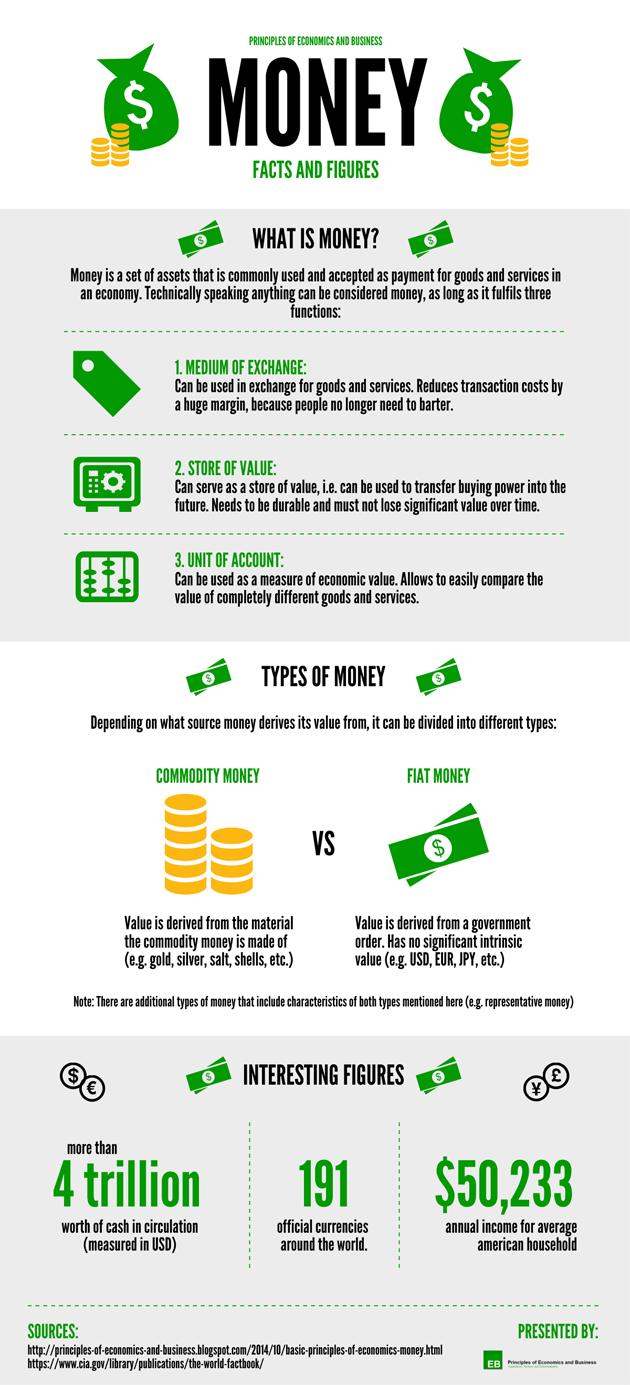
We all know what money is, right? We all use it, we go to work every day to earn it, we pay our bills with it. It's a part of everyday life. However, most people never think about what money really is. How it can be defined, what functions it has and what makes it valuable in the first place.

Generally speaking, money is a set of assets that is commonly used and accepted as payment for goods and services in an economy. So basically everything can be considered money, as long as it fulfills certain criteria. 

To explain this in more detail, we have created an infographic that displays some of the most relevant and interesting facts and figures about money. Take a look:


Infographic - Money: Facts and Figures


Embed Code

Wednesday, November 5, 2014

Report from the GEN conference

Wednesday was the Government Economics Network's annual conference at Te Papa in Wellington. This year the theme was "The relevance of economics in a changing world".

The keynote presentation was from Stanford's Paul Oyer, "The more things change, the more they stay the same: Four economic ideas everyone should know". His core theme was that, although many people post the GFC have criticised economics for not predicting it, or not understanding it, or even for causing it, economics has core concepts that were valid pre-GFC and are just as valid now. He picked four - cost-benefit analysis, equilibrium, thinking on the margin, and the limits of markets, all operating in the context of people aiming to maximise something in an environment of limited resources - and gave lively examples (funeral parlours in Tennessee, dog care services in Georgia) where these principles played out in real life. However, he also felt (quoting Princeton's Alan Blinder) that too much of economists' attention is taken up with arcana, and that the practical, useful, workaday economics, far from the bleeding edge academic frontier, was relatively neglected. That said, he ended up by saying that economics remains a powerful way of better understanding the world we live in, of helping to operate businesses more efficiently, and of setting policy for the greater good.

Not everyone agreed with his view - there was one pointed statement-cum-question from the floor saying that economics had fairly and squarely walked us into the GFC mess, and that the economics trade is in denial if it thinks it didn't - but I felt Oyer was broadly on the right track. The babies and bathwater criticism of economics has always seemed overdone to me, and I'd probably chuck in some further concepts that have also had enduring value (trade-offs, for example).

The next session was on "Economic analysis for policy", which exposed us to some applied techniques. Leo Dobes from the Australian National University talked about options, and the importance of allowing for the value of options in making decisions, and Caroline Saunders from Lincoln showed us examples of choice modelling, trade modelling, and modelling of sectoral comparative advantage. The choice modelling in particular was fascinating: Caroline showed us a real world example of how it had been used to identify the importance of various consumer criteria (such as safety, sustainability, country of origin) to overseas purchasers of our agricultural exports, which in turn could be used to profitable marketing effect in different overseas markets.

The next session, on "Teaching economics at university", wasn't so great.

The first speaker, Michael Mintrom from Monash, spent a good deal of his time on bringing an investment perspective to public policy development, which I thought was fine in itself, but not fully on-topic. He did get round to what you might want to teach people in university, if they're going to provide that perspective, albeit late in the piece. And it was quite good when we got there: I jotted down cost-benefit analysis models, experimental design with control groups, comparative institutional analysis, ex post opportunity cost studies, how economic insights can support social outcomes, learning from policy mistakes and near-failures, setting students 'capstone' projects which combine theory and application.

I didn't enjoy the presentation by Victoria's Morris Altman at all, principally because the delivery was painful to sit through (screen after screen of text paragraph bullet points, read verbatim). His core point was that it is a good idea to bring a mix of techniques and perspectives to any given problem.

Ashleigh Cox, a master's student at Waikato, gave us an interesting perspective from the other side of the lectern. She was concerned that her undergraduate economics hadn't seemed to give her the insights she'd have liked on issues such as exchange rates, housing, or inequality, and that it was only later and further reading that left her better equipped (mind you, I'd say that's probably true of a lot of things, and most of us have learned more about a subject post school or post college than we ever learned at the time). And she was also concerned about what (I think) she called "economics imperialism", or economics attempting to be a Grand Theory of Everything, and not doing it well at all.

Her comments got the discussion going, both in the hall and around coffee afterwards. Mostly I got the impression that all is not as well as it might be with teaching economics in New Zealand (and there are similar discontents overseas). Comments I picked up: not enough real-world applied economics on the menu; three-year, short-trimester economics degrees don't leave enough room to add the bits that would give a broader perspective to an economics education (such as economic history, or the history of economic thought); not enough effort going into making sure that students have an intuitive understanding of concepts, as opposed to parroting back equations (I was suddenly reminded of a piece George Orwell once wrote about a rote-leaning school student in the UK blindly reciting, "The root cause of the French Revolution was the oppression of the nobles by the people"); and degree courses being overdesigned for the student on the PhD track (heavy on the maths and the theory).

I snuck in a "mostly" qualification earlier, and that's because I also talked to some (younger) people who were very satisfied with what they'd got in New Zealand. As was I with mine in Ireland (Trinity), but then I did get some economic history, and some compulsory politics options, that rounded things off better than some modern economics courses seem to manage.

And we finished with an excellent session on the "Economist as Policy Advisor", from two battle-hardened pros - Graham Scott, formerly Secretary to the Treasury, and the NZIER's John Yeabsley - who've seen it all, and have the war stories to prove it. Graham had led off with an impressively erudite history of the role of advisers to rulers, but we moved on from Athenian democracy to wrestling with Muldoon in short order. I'd guess the many policy analysts in the room will have taken away good ideas on how to handle some of the trickier issues - notably how to present advice that your Minister does not want to hear.

At the end we had an unscheduled appearance by one of those very Ministers, Max Bradford, who made two points that I recall. One was that the greatest difficulty he'd faced was breaking with the inertia of the status quo. The other was that it might have been useful to have had some Ministerial customers of policy advice on the panel for the session, to give their perspective, and I think he was right.

Tuesday, October 21, 2014

Money, Money, Money

For many people, money is equal to bills and coins. However, even though this is not wrong, it is only one part of the equation. Generally speaking, money is a set of assets that is commonly used and accepted as payment for goods and services in an economy. This suggests that anything can be considered money, as long as it fulfills certain criteria (i.e. as long as it is generally accepted).

To really understand what money is, we must therefore look at the relevant functions it performs within the economy. To keep things simple, we will focus on the three most important ones here: money as a medium of exchange, a store of value, and a unit of account.

1) Medium of exchange
Money can be used in exchange for goods and services. This reduces transaction costs by a huge margin, because people no longer need to barter. In other words, you can just walk into a store and buy a pair of jeans (or whatever you need) in exchange for your money. This only works as long as the seller is confident, that he will be able to use the currency he receives to buy goods or services of equal value later on.

2) Store of value
Money can serve as a store of value. That means, it can be used to transfer buying power into the future. If you sell your car for instance, you can keep the money for a while and use it to buy a new car later in the future. For that reason money needs to be durable and must not lose its value over time. 
Please note that this may not be perfectly accurate in reality, as money can actually lose some of its value due to inflation. However we consider this effect negligible for now (but we will cover it later).

3) Unit of account
Money is also a measure of economic value. Every good you can buy in a shopping center has a price tag on it. Thanks to that we can easily compare the value of completely different goods. To give an example, you may want to buy some ice cream for 2$ and a shirt for 20$. By comparing the prices you know that the ice cream is worth about 1/10 of a shirt. Using money as a unit of account is very convenient because it allows us to compare virtually everything. 

In a nutshell:
Money is a set of assets that is generally used and accepted as a medium of exchange for goods and services in an economy. Apart from its function as a medium of exchange, money also serves as a store of value and a unit of account. Everything that fulfills these three functions can be considered money.

Tuesday, October 7, 2014

The Importance of Economic Models

Models are a very important tool when it comes to understanding economic principles. Yet they are often subject to criticism, mostly because many of them are said to be simplistic and far away from reality. Because of that the importance of economic models is often underestimated.

To be fair, the critics may have a point. The models are indeed simplistic and not always close to reality. But that is exactly what makes them great. To keep things short, they have two very important functions.

1) Models simplify reality
There is no point in creating a model that describes every detail of a certain object. For example, there is no need to build a model of a car that is 100% identical to the actual vehicle. In that case we could just look at the car itself.
Instead a good model will omit certain details and build on certain assumptions. This will make it much easier for us to examine it and actually learn something.

2) Models guide our attention to certain topics
The second function is very much connected to the first one. By omitting certain details while keeping others, the model automatically guides our attention in a certain way. Depending on what we are trying to learn, the model can put the focus on different topics. At this point it is important to note that including different details will dramatically change the quality and purpose of every model. 
Now that has implications for our car example. If for instance we are trying to figure out how an engine works, we need to include all the relevant rods, wheels and pins into the model. The bumper design however is not relevant and can be omitted. Naturally these relevant details are entirely different if we are trying to create a new design for our car and so on.

In a nutshell
Models are very powerful tools that help us comprehend economic principles by simplifying reality and guiding our attention to specific features of an object.

Looking at economic models the right way will come in handy as we are learning more about economics. Sometimes even looking at what is not included can help us understand what a topic is all about.

Monday, October 6, 2014

Macroeconomics vs. Microeconomics

The study of economics can roughly be divided into two branches: Macro- and Microeconomics. For the sake of completeness, there are certain other branches as well, but differentiating between those two will be good enough for us (for now).

The two disciplines look at the economy from different perspectives. While macroeconomics can generally be described as the study of the economy as a whole, microeconomics is often referred to as the study of small economic units (such as households, firms, specific markets, etc.). However, it is important to note that the two are still interdependent in many ways.

To see why we should not treat the two discipline completely isolated from each other we need to examine them in a bit more detail.

Macroeconomics
As the name suggests, the field of macroeconomics looks at the economy on a very broad scale. It analyzes the behavior of the entire economy. To do this it often makes use of aggregated variables, such as aggregated demand or aggregate production, and so on. The goal is then to find relationships and interdependences between those variables. 

Some of the topics that are covered in macroeconomics are:
  • Monetary and fiscal policy and its effects
  • Taxes
  • Interest rates
  • Economic trends (booms and recessions)
  • Economic growth
  • Trade and globalization

Microeconomics
Again the name implies that microeconomic studies look at the economy on a small, detailed scale. It analyzes the behavior and decision making of individuals and companies within an economy. By doing so, it builds the foundation for many macroeconomic studies, as it provides the data to calculate the aggregate variables mentioned above.

The topics that are covered in microeconomics include:

In a nutshell:
Macroeconomics is the study of the economy as a whole (from a broad perspective) and microeconomics is the study of small units (from a close perspective). Even though they cover different areas of economics, they are still highly interrelated and should not be isolated from each other.